Some Volvos Cleaned Ozone From the Air With Their Radiators
by AutoExpert | 16 October, 2026
What did Volvo’s PremAir radiator do? Its catalytic coating converted some ground-level ozone in the air passing through the radiator into oxygen. Volvo reported conversion of up to 75% in tests. That figure concerned ozone in radiator cooling air, rather than every pollutant around the car.
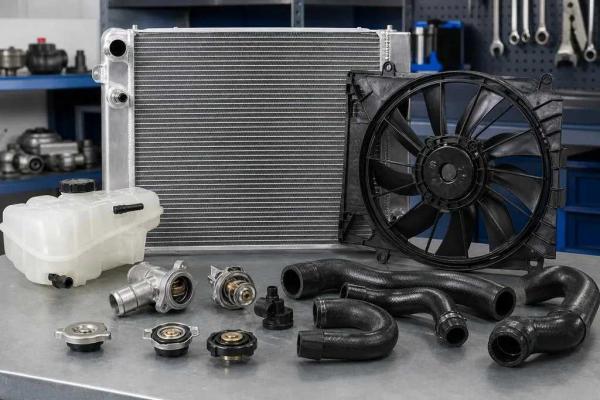
A radiator rarely gets much attention until it leaks. It sits behind the grille, doing an essential job without providing much for an owner to talk about. Volvo managed to give some of its radiators a rather better story.

They could help clean a pollutant out of the air.
The technology was called PremAir, developed by Engelhard in collaboration with Volvo. It took advantage of something a moving car already does: pass a large volume of outside air through its radiator. A catalytic coating on that surface converted ozone into oxygen as the air went through.
There was no extra task for the driver. No separate air-cleaning setting to remember before joining the traffic.
The percentage needs its context
In a September 2004 explanation, Volvo said tests had shown conversion of up to 75% of the ozone in radiator cooling air. It listed PremAir across several models in its international range, including the S60, S80, V70 and XC90, with market and specification qualifications.
That is an interesting claim on its own. It becomes misleading if shortened to “the car removed 75% of pollution.”
PremAir targeted ground-level ozone, one component of the smog problem. It did not collect everything coming through the grille, nor did treating outside air make the engine’s exhaust disappear. The radiator coating and the exhaust’s catalytic converter had different jobs.
BASF’s account of the technology makes that separation clear, describing the coated radiator as a direct ozone-reduction system alongside conventional exhaust treatment.
It is an unusual detail to find in a car’s equipment history because there is so little theatre involved. A panoramic roof announces itself. A more powerful engine encourages a test drive. A coating on a radiator is unlikely to occupy much of either.
Yet this was an attempt to make an ordinary component useful in another way, taking a surface already exposed to passing air and giving it a chemical function.
Anyone discovering PremAir while reading an old Volvo brochure could be forgiven for wondering whether the wording was a little ambitious. The underlying idea was real. The explanation simply needs to keep the radiator, the pollutant and the test result in the same sentence.