Mercedes Put an Airbag Beneath a Car to Help Slow It Before a Crash
by AutoExpert | 13 October, 2026
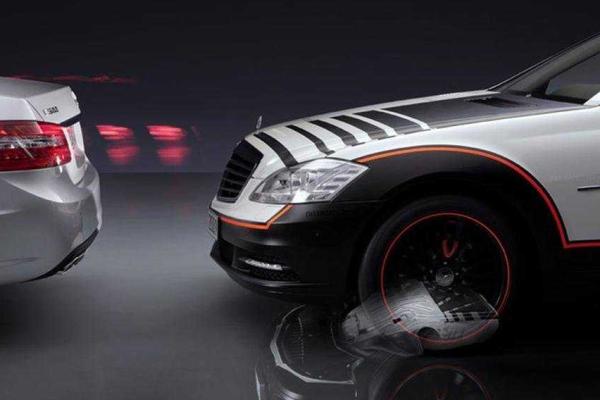
What was the Mercedes braking bag? It was an experimental underbody airbag shown as part of the ESF 2009 safety programme. When sensors judged a collision unavoidable, the device would deploy a high-friction surface against the road to provide additional braking. It was a research concept, not a showroom feature.
Airbags are usually hidden in places where an occupant might hit something: the steering wheel, the dashboard, the side of a seat. Putting one beneath the car seems an odd use of a familiar safety device.
Mercedes’ researchers had a different job for this one. They wanted it to help slow the vehicle before the impact.
The Braking Bag belonged to the ESF 2009 experimental safety vehicle, a programme used to explore ideas beyond the equipment already fitted to production cars. Some of its inventions looked recognizably related to ordinary restraints. An inflatable seat belt, for example, offered a wider surface to distribute forces across an occupant.
The device beneath the floor was considerably less familiar.
One last opportunity to lose speed
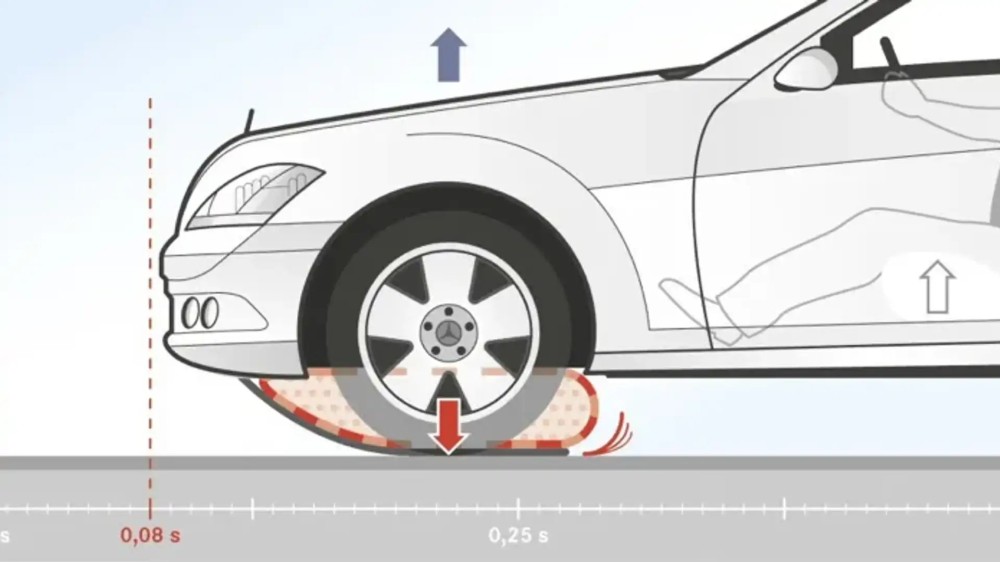
Mercedes’ description placed the bag between the front axle carrier and the underbody covering. It would deploy shortly before an impact judged inevitable, pressing a friction-coated surface against the road while the car also braked conventionally.
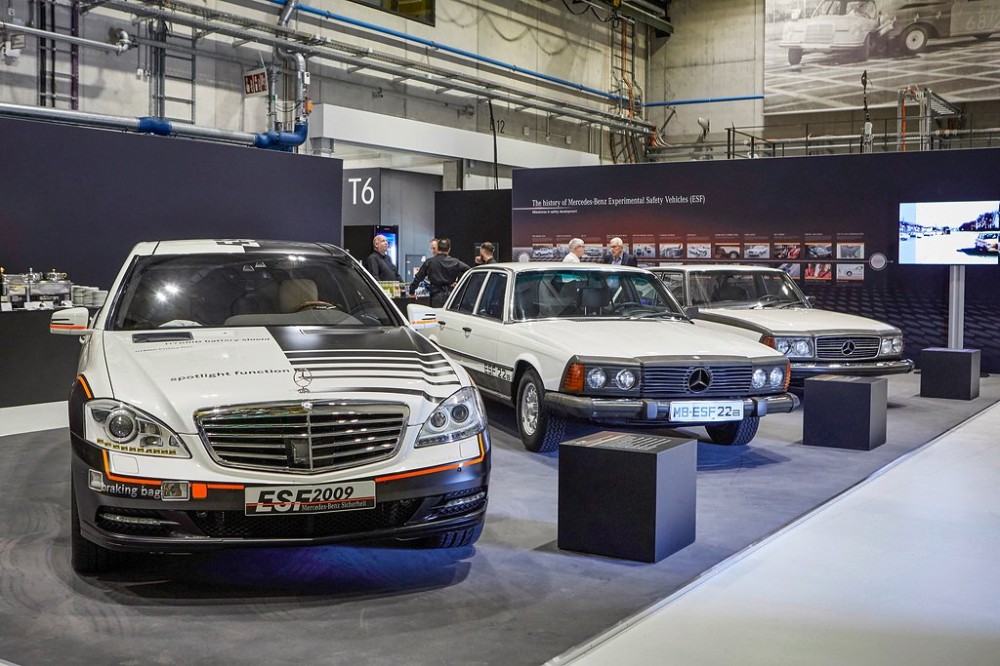
The intended benefit was extra deceleration during the brief interval still available. Less speed at impact could mean a less severe collision. Mercedes also described an upward movement intended to counter the nose-down attitude produced by hard braking, improving how the vehicle’s structure met the other vehicle.
That is quite a lot to ask of a bag in a very short time. It also explains why this was an experimental system rather than another button for the driver to press.
The interesting engineering problem was deciding when to use it. A device meant for an unavoidable impact has to work within that narrow situation. Deploying while a driver still has an opportunity to steer away would be a very different proposition.
Research vehicles allow questions like that to be examined before a feature is ready for ordinary traffic. An impressive demonstration is part of the work, rather than proof that all the practical problems have been settled.
Mercedes’ own history records the ESF’s inflatable seat belt reaching series production in the 2013 S-Class. It lists the Braking Bag as an experimental auxiliary brake, without a corresponding production introduction.
That distinction is useful when footage resurfaces online. The demonstration shows an idea Mercedes investigated, not a hidden feature waiting beneath every S-Class.
It remains a striking piece of automotive research because the physical action is so easy to understand: place another high-friction surface against the road when the tires and brakes are already working hard. Whether a solution reaches production or stays in the laboratory, there is something fascinating about watching engineers reconsider which parts of a car might help stop it.