Citroën Built a Rotary-Powered Helicopter, and It Actually Flew
by AutoExpert | 6 October, 2026
Among the cars in Citroën’s heritage collection sits something that makes even the company’s stranger experiments look quite sensible: a helicopter. Two seats, a bubble-like cabin and a rotor overhead. It carries the same double-chevron badge found on the bonnet of a French family car.
The RE2 was a working aircraft, powered by the kind of engine most enthusiasts associate with Mazda sports cars. On Christmas Eve in 1975, it took off at Citroën’s La Ferté-Vidame test site. A car manufacturer had built itself a rotary-powered helicopter. Citroën’s own history records both the flight and the eventual cancellation.

That sounds like a spectacular distraction from building cars. Follow the engine, though, and the decision becomes easier to understand.
The rotary engine needed somewhere else to go
Citroën had invested in Wankel technology with German manufacturer NSU. Their joint engine company, Comotor, was established in 1967, with ambitions that extended well beyond a curious mechanical experiment.
A conventional piston engine repeatedly sends its pistons up and down. A Wankel uses a roughly triangular rotor moving inside a shaped housing. Its compact layout and smooth operation made it an appealing alternative, especially to engineers willing to reconsider how an engine ought to work.
Citroën tried the idea in the experimental M35 and then the production GS Birotor. It also developed a larger, more powerful version for the RE2, according to the manufacturer’s account of its rotary program. The helicopter therefore belonged to the same engineering adventure as the cars, even if it required rather more headroom.
Aircraft put a particular premium on getting useful power from a light, compact package. Citroën’s original RE2 brochure promoted the rotary’s low vibration, favorable power characteristics and ease of installation. Those were the project’s selling points, rather than proof that an automotive engine could simply be bolted into any helicopter.
Citroën also brought in someone who knew the difference. Charles Marchetti, an experienced helicopter engineer associated with the Alouette II and Super Frelon, joined the effort in 1972. The RE2 program launched the following year.
Getting airborne was only part of the job
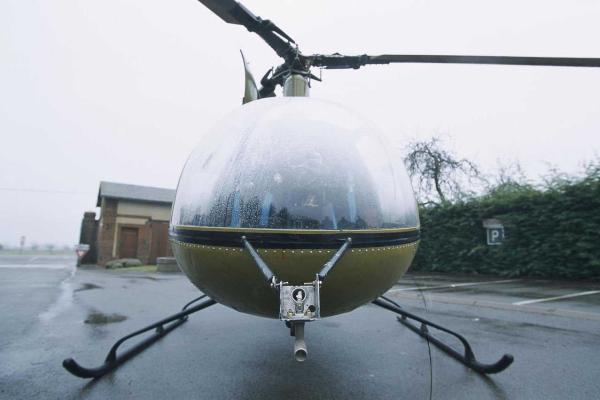
The resulting machine had two seats and a three-bladed main rotor. Citroën lists a single example in its heritage records. Photographs show a compact cabin ahead of the mechanical equipment, with a slender tail extending behind it. There is little of the motor-show fantasy about its appearance; it looks like equipment built for testing.
Its successful first flight gave the project something a beautiful drawing never could. Still, a flying prototype leaves an enormous amount of work between the test site and a customer. Production, support and the economics of operating it all have to make sense.
The timing was especially unkind. Citroën’s historical account connects the rotary venture’s difficulties with the oil crisis of the 1970s. An engine’s attractive size and smoothness could no longer carry the argument on their own when fuel consumption had become such an urgent concern.
The company stopped the helicopter project on May 5, 1979. No production fleet followed, and the surviving RE2 became a particularly unexpected member of Citroën’s collection.
For anyone accustomed to seeing carmakers unveil aircraft-shaped concepts that never leave a stand, the Christmas Eve flight is the detail to remember. Somewhere in the French countryside, a helicopter wearing a Citroën badge really did lift off.