Citroën’s Solution to Four-Wheel Drive Was to Put Another Engine in the Boot
by AutoExpert | 9 October, 2026
Open the boot of most small cars from the 1960s and you would expect shopping, a spare wheel or perhaps a toolbox. In a Citroën 2CV Sahara, the engine would be taking up much of that space. The other engine was where an engine normally belonged, under the bonnet.
Citroën had turned its humble little car into a four-wheel-drive machine by giving each axle a powerplant of its own. It sounds like the sort of modification someone might build in a shed and spend years explaining. The company developed it into a production vehicle.

There was work waiting for it. Oil exploration in Algeria, along with demand from French postal and forestry services, encouraged Citroën to develop an all-terrain 2CV. Low weight was a virtue worth preserving, even if the answer involved an extraordinary amount of extra machinery.
Starting the car was only half the job
An account published in Autocar on March 14, 1958, now preserved by Citroënët, described the early prototype’s second engine and transmission tucked into the rear compartment. Each engine displaced 425cc and had two horizontally opposed cylinders.
The arrangement meant two gearboxes as well as two engines. Controls linked the powertrains so the driver could use one gear lever and accelerator, rather than attempt an elaborate performance with both hands and feet. Separate starting controls remained necessary.
A conventional 4×4 sends power from one engine to both axles through its drivetrain. The Sahara’s rear wheels had their own source of power. The rear engine installation even required reversing the final drive’s rotation, a small detail with fairly obvious consequences if overlooked.

The physical changes went beyond finding somewhere to squeeze in an engine. Citroën’s official history describes a reinforced chassis, rear bodywork adapted for cooling, and two fuel tanks beneath the front seats. Both engines could operate together, or the car could run using the front one alone.
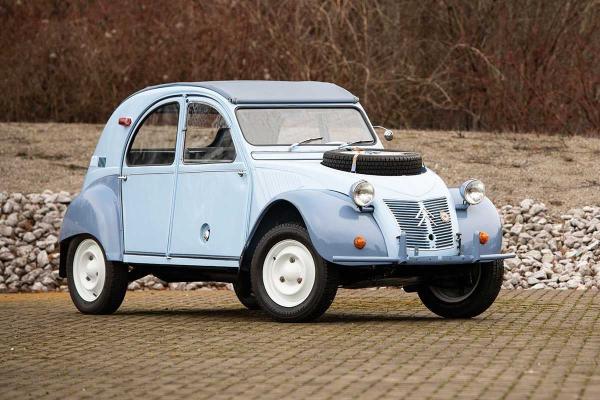
From the outside, it still looked recognizably like a 2CV. That familiar shape is part of the pleasure: the machinery beneath it was far stranger than the body suggested.
Cheap-car ancestry, expensive-car price
Doubling a 12-horsepower engine did not turn the Sahara into a sports car. What mattered was getting power to four wheels while keeping the vehicle light enough to make useful progress on difficult ground.

The complication was the price. Citroën says the Sahara cost more than two ordinary 2CVs. Small-scale production and specialist engineering had pushed a car with inexpensive origins into a very different buying decision.
An operator who needed its particular abilities could see the point. A customer who simply wanted an affordable family car had little reason to pay for an extra engine, another transmission and the associated maintenance.
Seen now, the Sahara is easy to admire as a glorious oddity. Its appeal runs deeper than the novelty, though. There was a specific problem to solve, and Citroën was willing to pursue an answer that made the boot a decidedly unsuitable place for groceries.