

Before Turning That Uncomfortable Headrest Around, Try the Adjustment in the Manual

by AutoExpert | 22 October, 2026
If a car’s head restraint pushes your head forward, check the seat setup and the adjustment instructions for that model. Some restraints tilt as well as move vertically, and their reset mechanism can be easy to miss. Reversing or removing one can compromise its intended protective position.
You get the seat distance right, adjust the steering wheel and settle back. Then the headrest seems to insist that you look down at your knees.
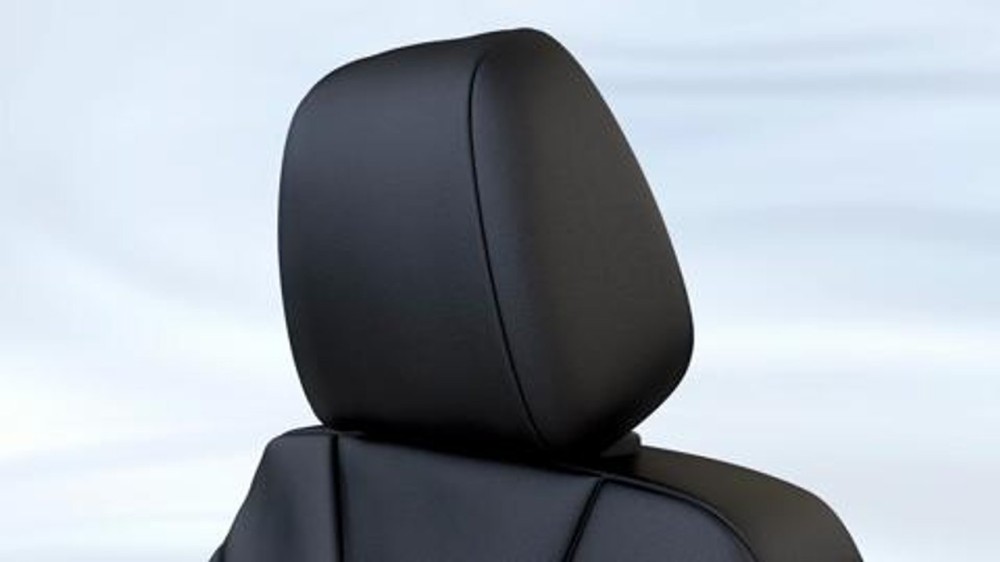
Moving it higher does not seem to help. Pushing it backwards achieves nothing. Turning it around starts to look like an appealingly simple solution.
Before doing that, find out whether it is already tilted into a position you did not choose.
Some Ford head restraints use a ratcheting adjustment that is not especially obvious. They move forward through several positions, but pulling them backwards does not reset them. Instead, the instructions say to move the restraint fully forward, then farther forward again to release it to the rearward position. Ford specifically warns against forcing it backwards.
If you have been tugging at one in precisely the wrong direction, that is useful information. It is also a reminder to check the manual before trying the same trick on another car. Not every restraint has that mechanism.
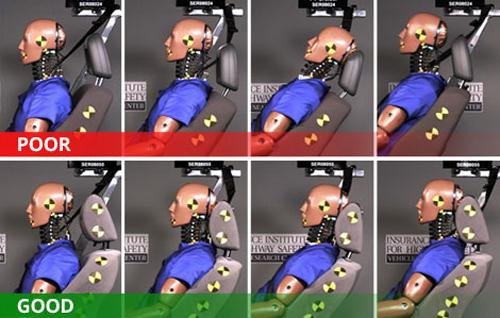
The reason its position matters is less comfortable to think about. In a rear impact, the seat moves the torso forward while the head can lag behind. A properly positioned head restraint helps limit that relative movement. IIHS explains that the distance between the back of the head and the restraint, known as backset, should be as small as possible.
So the forward shape is not necessarily a design mistake, even if it feels awkward in your current seating position.
Make the adjustments while parked, starting with the seatback and then the restraint, as the manual directs. In Ford’s example, the instructions call for an upright driving position, the top of the restraint level with the top of the head, and a forward position that remains comfortable.
If you bought the car used, there is another reason to check rather than assume: you are inheriting somebody else’s settings. A restraint tilted forward by the previous driver may stay there long after every mirror and seat control has been moved.
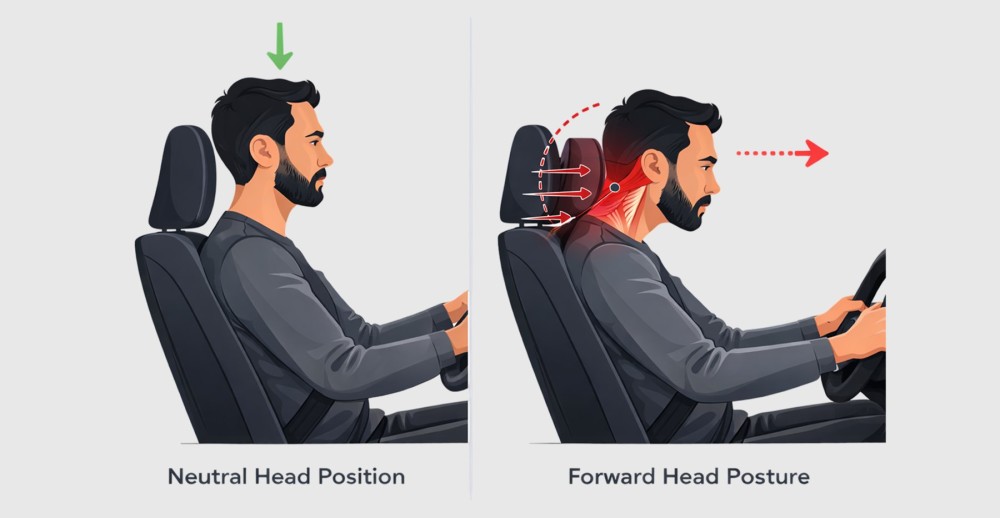
Sometimes the available adjustment still will not suit you. Ask the dealer to demonstrate the mechanism and check that the restraint is the correct part and installed properly. That is more useful than spending the next year driving with your shoulders held away from the seatback.
The aim is a driving position you can comfortably maintain, with the restraint doing its intended job. You should not have to choose between those two things before you have even discovered all the adjustments.