
Why There’s a Canyon in Utah Filled With Buried Classic Cars
by AutoExpert | 22 June, 2026
At first glance, it sounds like one of those roadside legends people half-believe because the story is too strange not to repeat.
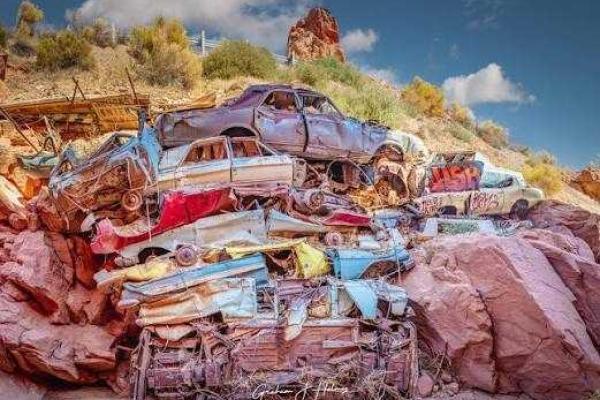
A hidden canyon in southern Utah. A wall made of old American cars. Not one or two abandoned wrecks, but stacks of them, crushed together and packed into the landscape like somebody decided the desert needed its own junkyard dam.
And somehow, the weirdest part is that it was done on purpose.
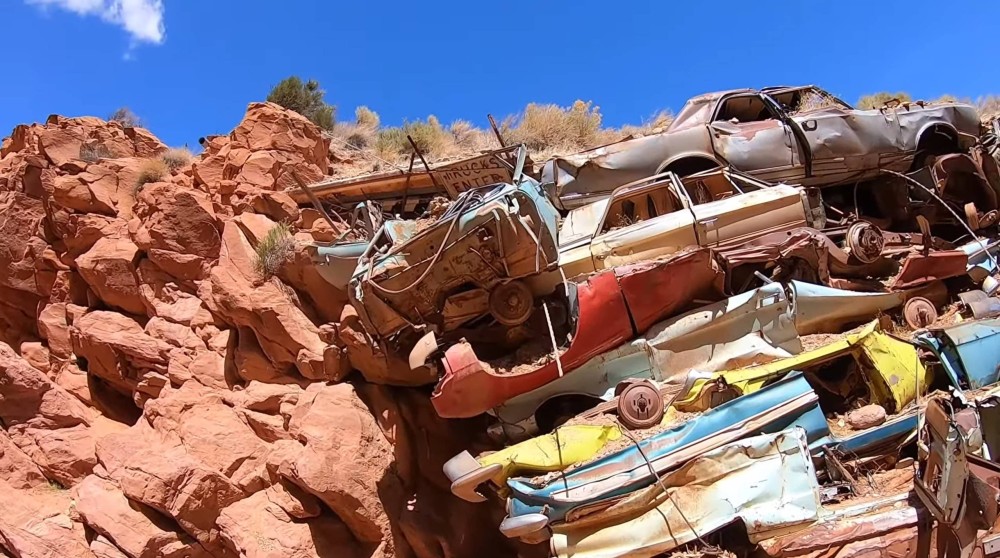
Tucked below Highway 89 in Catstair Canyon is one of those places that feels made up until you see it. Down in the wash, beneath all that open sky and red rock, sits a mass of rusted steel that has been there for roughly sixty years. Headlights, fenders, grilles, rooflines, old body panels pressed together into what looks like the aftermath of some forgotten automotive disaster.
But it was never meant as art. It was not vandalism, either. It was roadwork.
Back when engineers were carving the highway through that stretch of southern Utah, they had a problem: erosion. Sandstone washes are not exactly stable, and loose material has a habit of moving around when weather gets involved. They needed something to help hold the embankment together and keep the road from gradually losing its footing.
Normally, that kind of job calls for rock, concrete, or some other hard material. The technical term is riprap, which is basically a fancy engineering word for “stuff piled where nature keeps trying to wash things away.”
In this case, the “stuff” happened to be old cars.
That sounds ridiculous now, but in the 1960s it apparently made enough sense to the people building the road. Junkyards were full of cars that had little value left in them. Scrap markets were different. Steel was available, the bodies were large, and once the vehicles were crushed, stacked, and filled with gravel or packed into place, they created a dense barrier that could resist erosion surprisingly well.
So that is what they did.
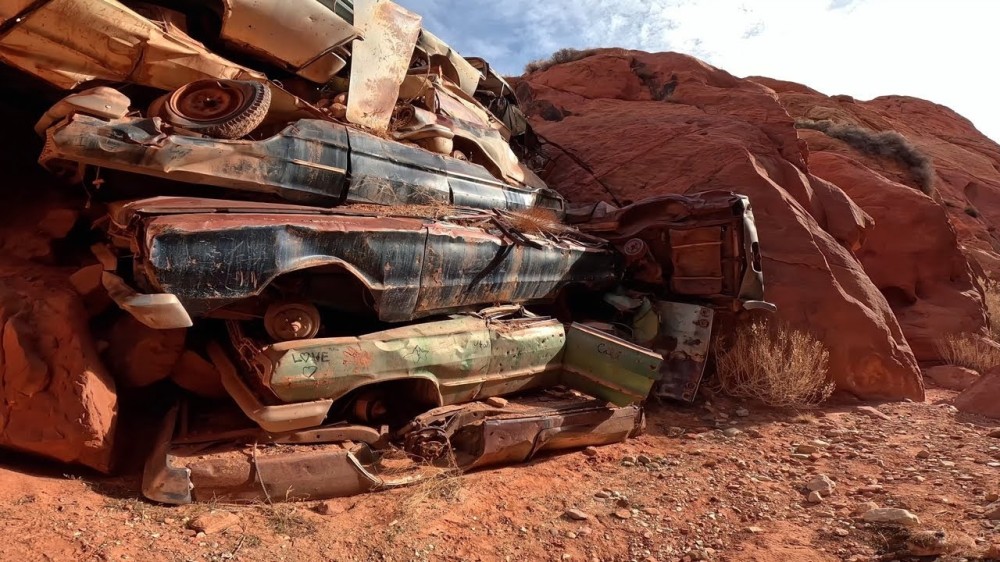
They filled part of the canyon with junked cars, buried much of the mess under dirt, and built the road above it.
There is something beautifully American about that solution. Not elegant. Not subtle. Just practical in a loud, slightly unbelievable way. We have a problem, we have a pile of old cars, let’s make one solve the other.
And somehow, it worked.
What makes the site so eerie now is that the cars never went away. Over time the desert preserved them instead of swallowing them. The dry air helped. The embankment compressed everything into a tighter mass. Decades of traffic rolled overhead. What remains today is this strange rusted wall of old Detroit sheet metal, sitting in a sandstone wash like a fossil record from the highway-building era.
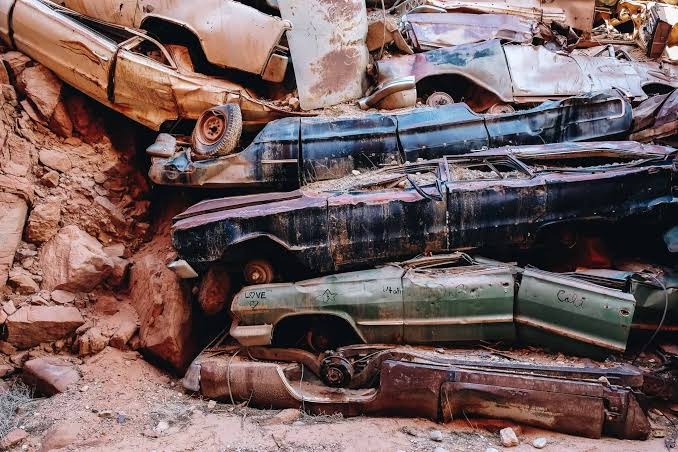
If you hike down there now, it does not feel like standing near a normal piece of infrastructure. It feels like stumbling onto a secret that the road forgot to hide properly. You see fragments of old American cars pressed into the earth, still recognizable in spots, even after all these years. Here a grille. There a bumper. A hint of a hood line. Bits of history trapped inside a retaining wall.
And because the whole thing is so bizarre, it has taken on a kind of mythic quality. People hear about it and assume there has to be more to the story. Maybe it was a dumping ground. Maybe it was some kind of outsider art project. Maybe it is one of those accidental landmarks that only became interesting because time made it weird.
But the truth is simpler, and maybe better for it.
It was an engineering shortcut from a time when road building often felt rougher, more improvised, and less worried about how things would look to future generations. Nobody was thinking, “This will become a strange little destination for curious hikers in sixty years.” They were just trying to hold the hillside in place.
That is part of the charm.
The place survives because nobody had a strong reason to undo it. The road stayed up. The wall stayed put. The cars became part of the canyon. And now what was once just a practical fix looks almost surreal, like a time capsule built by people who never imagined anyone would come back later and stare at it.
Which is probably why it sticks in people’s minds.
There are plenty of beautiful things in Utah. There are also plenty of strange things. This manages to be both at once: a rusted pile of forgotten cars in a sandstone canyon, somehow ugly and fascinating and weirdly perfect for the landscape around it.
It is not a monument. It is not exactly a ruin. It is more like a leftover idea from a different America, one where old cars were cheap, highways were expanding fast, and somebody looked at a canyon wash and thought, yes, let’s fill that with Buicks.
And, against all logic, here we are still talking about it.