The Last Jumper-Cable Clamp Should Not Go Where Most Drivers Put It
by AutoExpert | 28 July, 2026
Red goes to positive. Black goes to negative. It is the sort of rule that feels too simple to forget. It is also incomplete.
When jump-starting many modern cars, the final black clamp is not supposed to be attached directly to the negative terminal of the discharged battery. The vehicle’s instructions will commonly direct it to a designated grounding point or a solid, unpainted piece of metal on the engine or chassis instead.
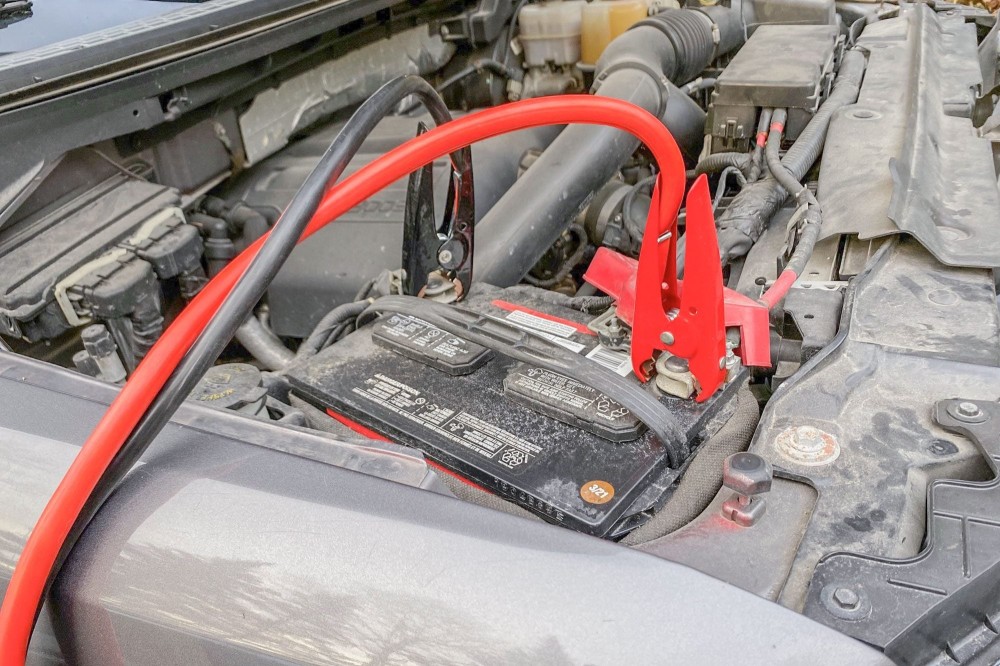
At first glance, this appears unnecessarily fussy. Electricity needs a completed circuit, and the negative battery post would certainly provide one.
The reason has less to do with whether the connection works and more to do with what can happen during the final second of making it.
The last connection is the one most likely to spark
A conventional lead-acid battery can release hydrogen gas, particularly while charging or under fault conditions. Hydrogen is highly flammable. A spark close to a battery containing accumulated gas can ignite it, potentially causing the casing to rupture and spray acid.
Jumper clamps often produce a small spark when the final connection completes the circuit. By making that connection at a suitable ground point away from the discharged battery, the spark is moved farther from the place where battery gas is most likely to be present.
The grounding point still completes the circuit because the battery’s negative side is connected to the vehicle’s metal structure and engine.
This is why the last black clamp may go on a substantial unpainted engine component, a manufacturer-provided stud or another location identified in the owner’s manual. Painted metal is a poor choice because the coating can prevent a reliable electrical connection. Thin brackets, fuel-system components and moving parts are not appropriate either.
The owner’s manual settles the matter because vehicle designs vary enormously. Some batteries are buried beneath seats, under luggage floors or behind trim. In those cases, manufacturers often provide remote positive and negative jump points under the hood specifically for this job.
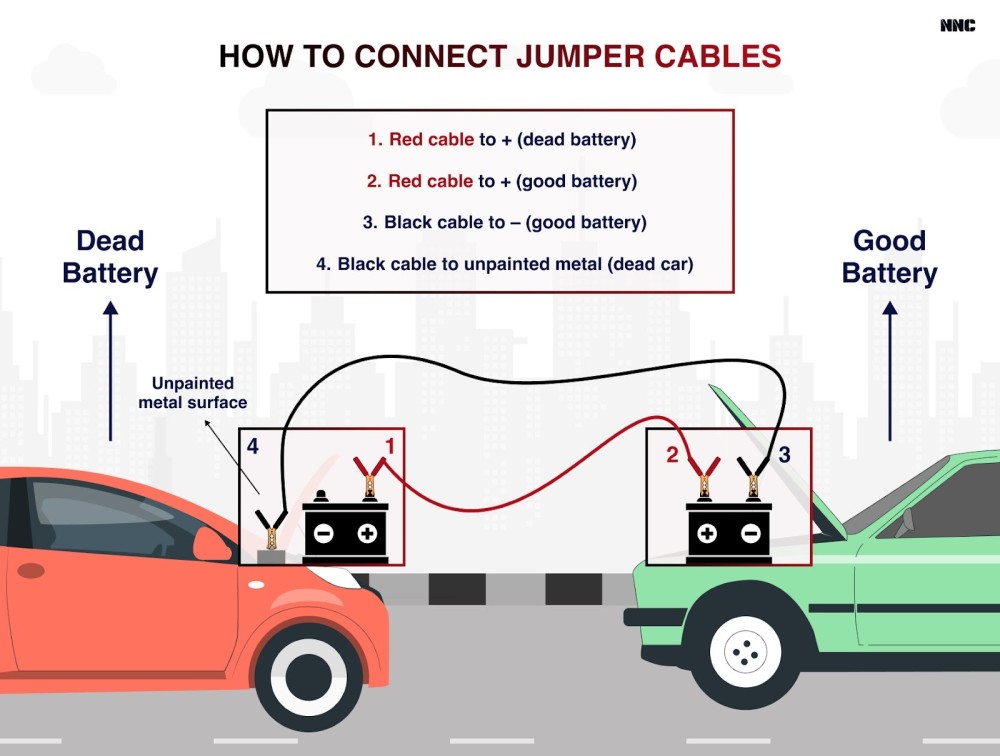
The familiar four-clamp sequence
For a typical negative-ground vehicle, the usual sequence begins with both vehicles switched off and positioned so they are not touching.
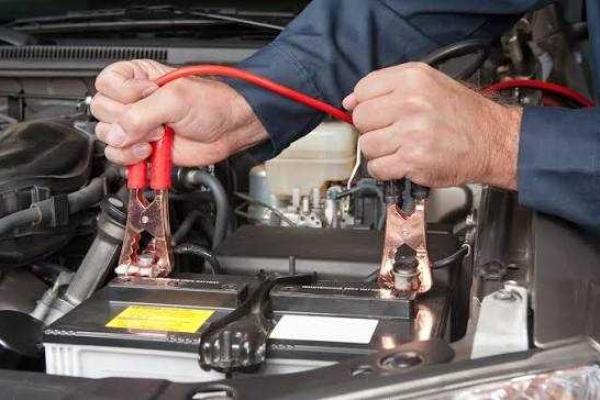
The first red clamp attaches to the positive terminal or positive jump post of the disabled vehicle. The second red clamp connects to the donor battery’s positive terminal. The first black clamp goes to the donor battery’s negative terminal. The remaining black clamp makes the final connection at the approved ground point on the disabled vehicle.
Starting and waiting instructions differ between manufacturers, so the manual should be followed rather than an improvised routine remembered from decades ago.
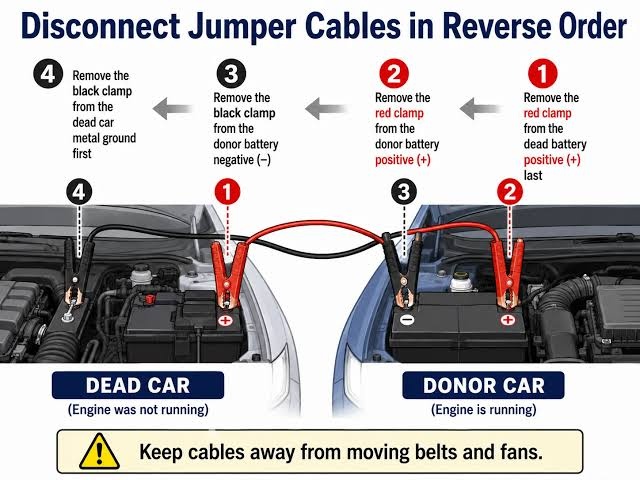
Once the disabled vehicle is running, the cables are generally removed in the reverse order. Keep loose cables away from fans, belts and pulleys. Those components may begin moving unexpectedly, even on vehicles with engines that appear quiet.
Polarity deserves more than a hurried glance. Connecting positive to negative can damage sensitive electronics, blow high-current fuses or create intense arcing. If the terminal markings are dirty or difficult to see, clean enough of the area to identify them before attaching anything.
Guessing is not part of a safe jump-start.
When the cables should stay in the trunk
A battery that is cracked, leaking, badly swollen or visibly frozen should not be jump-started. Neither should a vehicle surrounded by a strong fuel smell or showing obvious fire damage.
Modern hybrids and electric vehicles require particular care. Their high-voltage traction batteries are not jump-started with ordinary cables. Some models allow access to a separate 12-volt system so the car’s computers and contactors can wake up, but the exact procedure varies. The manual is essential.
A jump-start is also not a cure for the underlying problem. If the battery went flat because a light was left on, a sensible drive or proper charge may restore it. If it has a failed cell, weak alternator or persistent parasitic drain, the car may refuse to restart as soon as it is switched off.
The humble black clamp carries more responsibility than it appears to. Putting it on a proper ground point takes only a few extra seconds, and it moves the spark away from the one place it should never be invited.