
Why Is “Objects in Mirror Are Closer Than They Appear” Printed on Only One Mirror?
by AutoExpert | 27 July, 2026
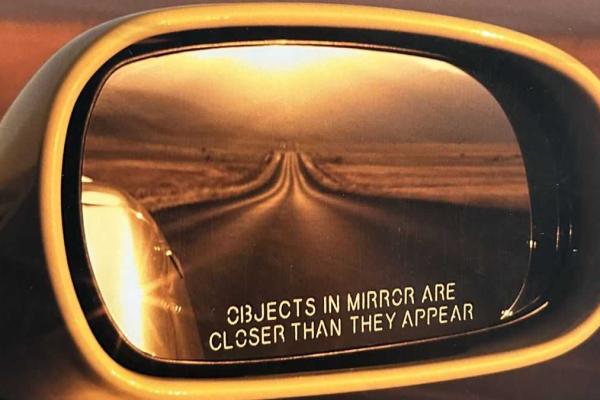
It may be the most famous sentence ever permanently printed on a car. “Objects in mirror are closer than they appear.” The wording has turned up in films, songs and countless jokes, but it began as a serious warning about an optical compromise. The passenger-side mirror gives the driver a much wider view than a flat piece of glass could provide. In exchange, it makes surrounding vehicles look smaller.
Smaller objects tend to look farther away. Hence the sentence. What makes the warning more interesting is that it usually appears on only one side of the car. The driver-side mirror, sitting only a couple of feet away, is doing a slightly different job.

One mirror favors distance, the other favors coverage
The driver-side mirror on a typical U.S.-market vehicle is flat. It reflects objects without significantly changing their apparent size, making distance easier to judge.
Its weakness is coverage. A flat mirror sees a relatively narrow slice of the road, which is one reason poor adjustment can leave enough space beside the car to hide another vehicle entirely.
The passenger mirror is much farther from the driver. If it were also flat, its useful field of view would be frustratingly narrow. To solve that problem, manufacturers use convex glass, curved gently outward.
A convex mirror captures light from a wider area. The driver sees more of the lane beside the car, but every reflected object appears smaller. A vehicle that looks comfortably distant may be close enough to make a lane change dangerous.
The mirror has not moved the vehicle backward, of course. It has changed the image used by the brain to estimate distance.
NHTSA explains that U.S. requirements control how curved the passenger mirror may be, limiting both the amount of distortion and the reduction in image size. The etched warning is required so drivers unfamiliar with convex glass are not misled by what they see.
Why not make both mirrors convex?
Some countries and vehicle designs do use curved or partially curved mirrors on both sides. Aspherical mirrors are also common in other markets. These combine a more natural central view with a strongly curved outer section for additional blind-spot coverage.
U.S. regulations have traditionally taken a different approach. A flat driver-side mirror provides a familiar image and better distance perception, while the passenger side gains the wider view made necessary by its position across the cabin.
The arrangement is a compromise rather than a perfect solution. One mirror tells distance more naturally. The other shows more territory.
Blind-spot monitoring has not made either mirror irrelevant. Electronic systems can fail to recognize a fast motorcycle, a vehicle approaching at an unusual angle or something obscured by weather. They are useful assistants, not permission to stop looking.
The warning does not mean the mirror is unreliable
The passenger mirror can be trusted to show that something is there. It simply should not be treated as the only tool for deciding exactly how far away that object is.
Before changing lanes, check the interior mirror, the appropriate side mirror and the area beside the car. A brief shoulder check remains valuable where conditions allow. Signal early enough to give other drivers time to react.
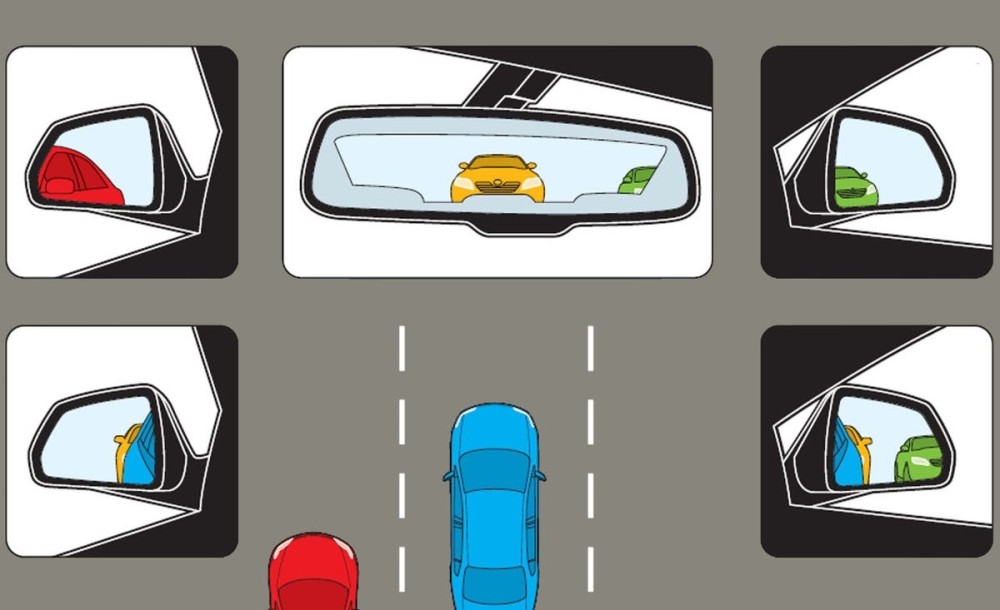
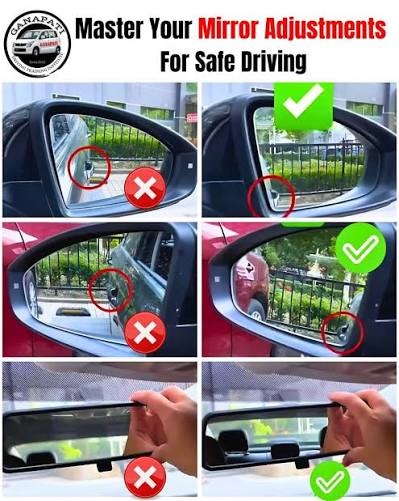
Mirror adjustment matters too. Many drivers aim both side mirrors inward until a large portion of their own car fills the glass. That creates a reassuring reference point, but it wastes much of the mirror on bodywork that is not going anywhere.
NHTSA research on mirror adjustment discusses angling the outside mirrors farther outward to reduce blind zones. The setting can feel strange at first because the side of the car largely disappears, but coverage of adjacent lanes improves.
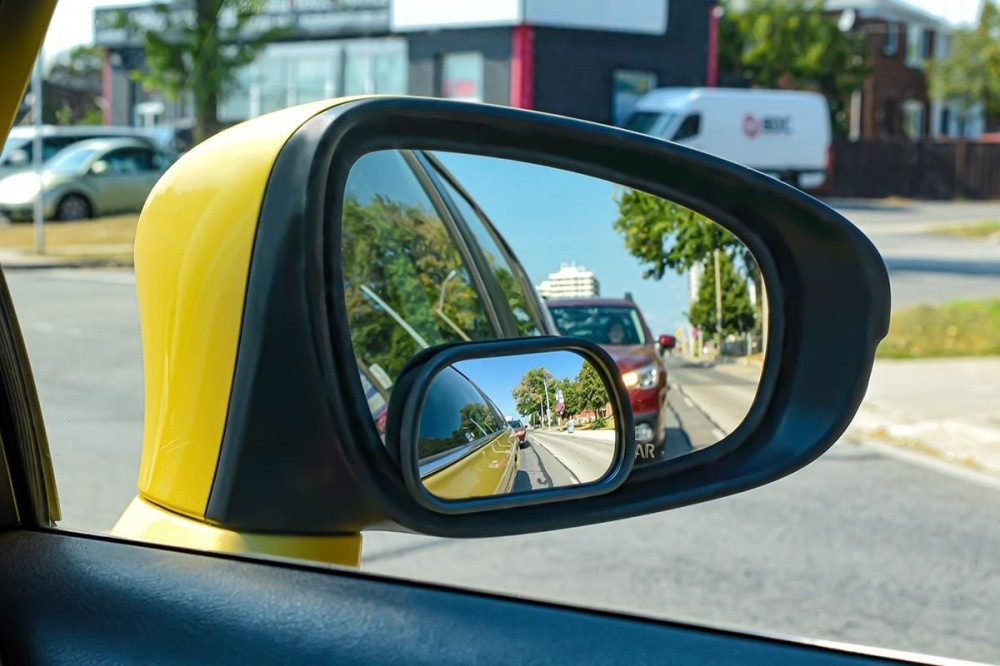
Small stick-on convex mirrors can add another view, especially on older cars without blind-spot monitoring. They should be positioned where they do not block the most useful part of the original mirror.
Replacement glass also deserves care. A mirror that fits the housing is not necessarily correct if its curvature differs from the original. The wrong glass can alter image size and distance perception, and a passenger-side convex replacement intended for U.S. road use should carry the required warning.
That familiar sentence is not legal clutter. It is the price of seeing more of the road from the far side of the car.
The mirror gives a wider picture. The words remind the driver not to mistake a wider picture for extra space.