
How Many Wheels Exist on Earth? A Realistic Estimate Based on Cars, Bikes, and Everyday Stuff
by AutoExpert | 13 February, 2026
That whole "wheels vs. doors" thing that blew up online a while back was hilarious. People got weirdly passionate arguing about which one there's more of. It turned into this massive debate with polls, memes, the works.
We're not settling that here. But it does make you wonder: how many wheels actually exist? You can't count them all, obviously. But you can take a stab at it by looking at what gets made and what's sitting around in our daily lives. The number is absolutely nuts.
Trying to Count Them
There's no wheel registry. Nobody's keeping tabs on every skateboard wheel or shopping cart roller out there. Any number is basically a guess based on manufacturing stats and industry data.
Car makers pump out about 94 million vehicles a year. Right now there are something like 1.6 billion vehicles on roads worldwide. Four wheels each gets you past 6.5 billion. Add spare tires, extra rims people buy, semi trucks with way more than four wheels, and you're at 7 to 8 billion from cars and trucks.
Bikes and motorcycles are huge too. Over 1.7 billion of them globally. Most are regular bikes, over a billion of those. Motorcycles and scooters make up another 700 to 750 million. Two wheels each means 3 to 3.5 billion more.
Where It Gets Weird
This is the part people miss. Wheels that aren't on vehicles. Your office chair has five. Shopping carts have four or five. Suitcases roll on wheels. So do vacuum cleaners, baby strollers, toy cars, skateboards, wheelchairs, lawnmowers, those little hand trucks, even your dishwasher if it's on rollers.
Warehouses have pallet jacks and forklifts. Airports have luggage carts. Hospitals have gurneys. Factories have conveyor belts loaded with rollers. Construction sites have wheelbarrows and cement mixers. Airport jet bridges roll on wheels.
Toys are probably the biggest category. Could be more wheels in toys than in all the cars and bikes combined. Office chairs alone add 1 to 2 billion. Everything else, carts, conveyors, manufacturing stuff, adds up to billions more.
Realistically you're looking at 10 to 20 billion wheels that aren't on vehicles. Could be way more.
What's the Total?
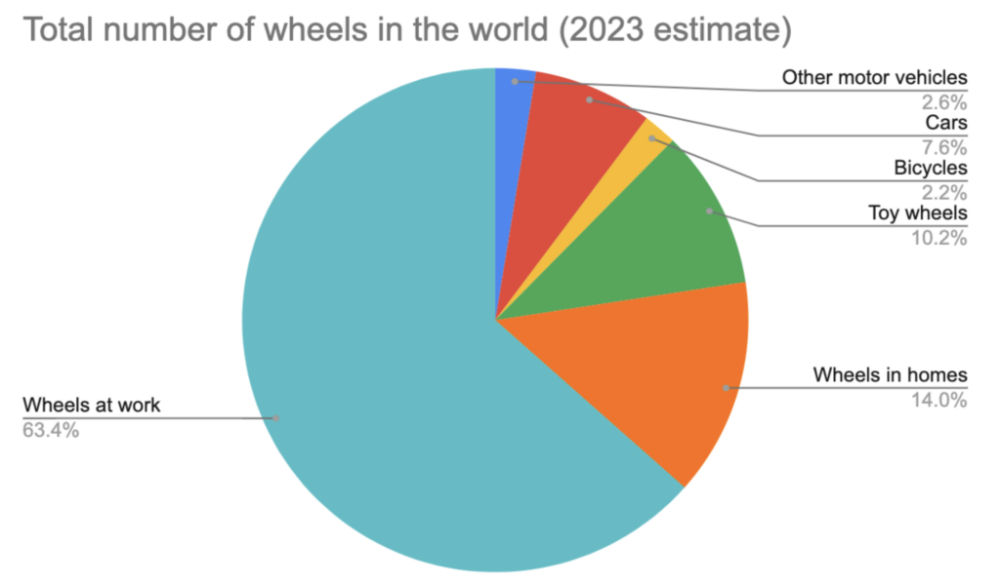
Cars and trucks: 7 to 8 billion. Bikes and motorcycles: 3 to 3.5 billion. Everything else: 10 to 20 billion, maybe higher. Best guess puts the total somewhere between 20 and 35 billion wheels on Earth right now.
Could be more. New wheels get made every day by thousands of factories. A lot of products with wheels never get tracked. Wheels get tossed, recycled, reused, and nobody's writing it down anywhere.
Why Are There So Many?
Wheels have been around for 5,000 years and they're still the best way to move stuff. Nothing beats them for reducing friction and rolling heavy loads across surfaces. That's useful in basically everything.
You can't have cars without wheels. Can't have supply chains. Warehouses need them to move products. Even little stuff like rolling your suitcase through the airport or scooting around in your office chair. Wheels just work.
The Problem
Billions of wheels means a lot of waste. Most are rubber, plastic, steel, or aluminum. Making all that takes a ton of energy. Getting rid of it is a pain.
Tires are the worst offenders. Millions of tons get thrown out every year. They're huge, tough to deal with, and leak nasty chemicals if they're dumped wrong. Piles of old tires catch fire and attract bugs. Smaller plastic wheels from toys and furniture clog up landfills too. They turn into microplastics and sit there forever.
Manufacturing wheels pumps out carbon emissions. Making synthetic rubber burns fossil fuels. So does forging steel rims and molding plastic. Then everything gets shipped around the planet, which adds more emissions.
Recycling tires is hard. They get ground up for playgrounds and running tracks, mixed into asphalt, sometimes burned for fuel. But a lot just pile up. Rubber lasts forever by design, so breaking it down isn't easy. Places without good waste systems end up with giant illegal tire dumps. Plastic wheels are even tougher to recycle. Most just become trash.
Can This Get Better?
Yeah, people are working on it. Retreading tires, where you slap new tread onto an old tire, works great for trucks and planes. Recycling tech is getting better at breaking tires down into usable materials.
Some companies are testing natural rubber from sustainable forests, or weird stuff like orange oil and dandelion rubber. For plastic wheels there's a push to use recycled plastic or materials that actually break down.
Manufacturing is slowly getting cleaner with better equipment and smarter supply chains. And honestly the easiest fix is just making wheels last longer. Better materials, better designs, easier repairs. Less stuff ends up in the trash.
It's not perfect but sustainability is becoming a bigger deal as more wheels get made. The idea isn't to have fewer wheels. It's to make them last and recycle them better.
Quick Stuff
Is there a real count? Nope. Too many industries making too many wheels. Only estimates.
Do wheels beat doors? Probably by a lot. Just think about all the toys, vehicles, and random rolling stuff out there.
Can you recycle tires? Yeah. You can retread them, grind them up for playgrounds, mix them into roads, or burn them for fuel. How much actually gets recycled depends on where you live.