
Gasoline Particulate Filters Are Coming to the U.S.: Why Ford’s 2025–2026 EcoBoost Trucks Get Them First

by AutoExpert | 4 March, 2026
Gasoline particulate filters, also called Otto or petrol particulate filters, are showing up in more modern cars to cut down on particulate emissions. Started in Europe and China back in 2017 and 2020. Now they're headed to the U.S. Certain 2025 and 2026 Ford models are getting them, especially the Maverick and F-150 with turbocharged EcoBoost engines. GM, Toyota, and Ram haven't added the tech for 2026 yet but they'll likely have to for 2027 and beyond to meet the EPA's latest emissions rules targeting "criteria pollutants."
Didn't Trump and the EPA just reverse course on emissions and the agency's greenhouse gas study? Trump administration did revoke the GHG standards but the rules about criteria pollutants under the Clean Air Act, which includes particulate matter, weren't touched. That means GPFs are probably here to stay.
Depending on how you see it, GPFs might not be your thing. But they do actually reduce particulate matter from exhaust. PM is a recognized health concern according to the EPA and gets created when engines burn fuel, gasoline or diesel. Around 73% of new cars sold in 2023, including light-duty trucks, had GDI engines according to the U.S. Department of Energy. The increased concentration of PM in crowded urban areas is potentially from road traffic.
GPFs Have Downsides Too
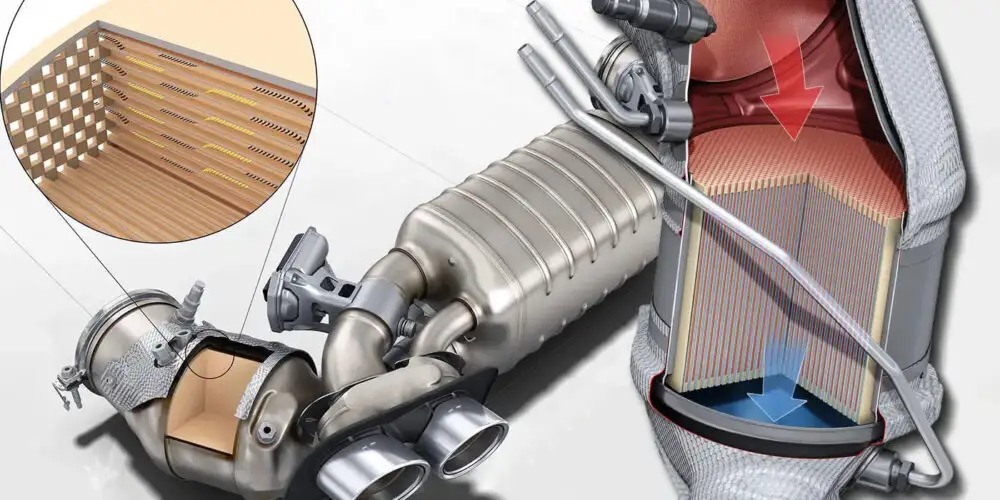
How they work, GPFs are very similar to diesel particulate filters but you can't just swap one for the other. Both are designed for their specific needs. Gasoline engines are less sooty and make finer particles than diesels so the honeycomb structure is generally more porous in GPFs. Sometimes GPFs are separate units, other times the filter's embedded in the three-way catalytic converter.
Do GPFs actually work? A 2022 study by two EPA researchers found particulate matter dropped up to 99% depending on test cycles after using GPFs in a 2011 Ford F-150. There are benefits, mostly environmental, but some drawbacks too.
Arguments about GPF regeneration and clogging seem valid. Build-up of soot and ash in the GPF can mess with exhaust back pressure, potentially leading to reduced engine efficiency. GPFs themselves can also interfere with power output and efficiency by creating back-pressure in the exhaust.
Most of the time regeneration, the self-cleaning process, is passive and barely noticeable. Unlike DPFs, active regeneration is really rare in gasoline engines since it temporarily increases nitrogen oxide emissions. Exhaust sound is another concern for enthusiasts. GPF cars sound relatively muted.