Before Every Car Got a Third Brake Light, 343 San Francisco Taxis Had to Prove It Worked
by AutoExpert | 7 September, 2026
A third brake light is remarkably easy to ignore. It sits in the rear window or above the tailgate, performs one job and receives considerably less attention than the lamps surrounding it.
That anonymity took decades to earn.
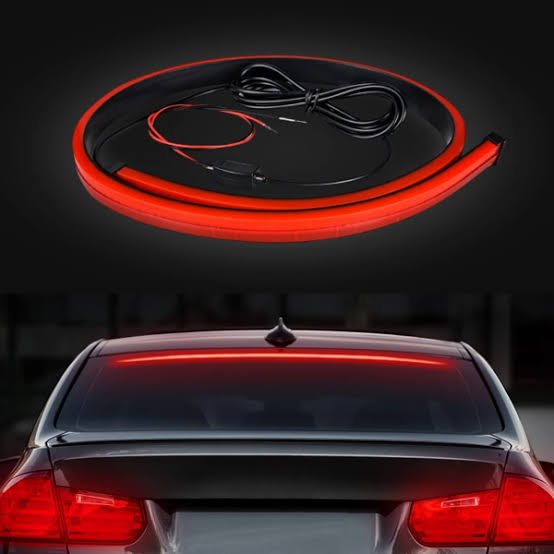
Before the lamp became a legal requirement, researchers had to establish whether placing one more red light on a car would genuinely prevent crashes or merely give manufacturers another bulb to install. One of the most influential experiments involved a psychologist, a busy American city and hundreds of taxicabs accumulating millions of miles in ordinary traffic.
A psychologist took the idea onto the streets
Rear-end collisions were already a stubborn problem by the early 1970s. Conventional brake lights sat low on the body, often beside tail lamps and turn signals. In dense traffic, the braking car might be several vehicles ahead, partially hidden by the car immediately in front.
Psychologist John Voevodsky believed that a separate light mounted higher and closer to the driver’s natural line of sight could communicate braking more clearly. He also wanted it to show the intensity of the deceleration.
In 1974, he tested the idea using San Francisco taxis. According to the National Academies’ account of the experiment, 343 taxis received an additional center-mounted lamp while 160 cabs continued operating without one.
This early light differed from the familiar red strip in a modern rear window. It was amber, and its pulse rate, brightness and timing changed according to how sharply the taxi slowed. A gentle reduction in speed produced a different warning from hard braking.
The taxis carrying the experimental lamps covered approximately 12.3 million miles. The control fleet traveled another 7.2 million. When the collision records were compared, the equipped group experienced a reported 60.6 percent reduction in rear-end crashes.
Those results were difficult to dismiss. They also did not send Voevodsky’s exact design directly into production. A pulsating amber deceleration display conveyed more information than a conventional brake lamp, but it also asked following drivers to interpret an unfamiliar signal.
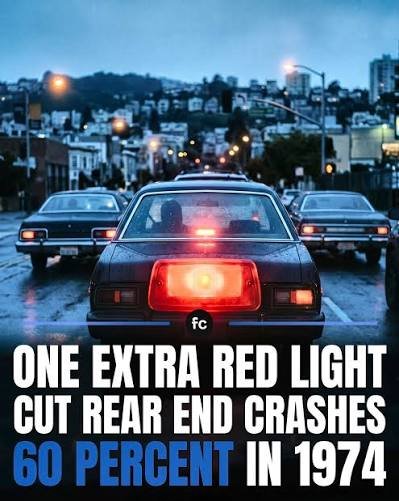
The industry eventually adopted the simpler part of the idea: place an unmistakable brake light high and in the center.
Why the position matters
The official name, center high-mounted stop lamp, sounds as if it was created by a committee determined to remove all personality from a very useful object. The abbreviation CHMSL is not much friendlier.
Its location is the clever part.
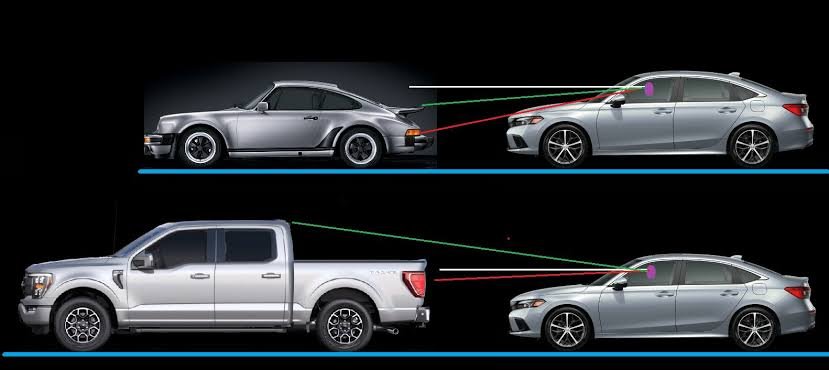
Because the lamp sits above the two conventional brake lights, it can remain visible through the windows of the vehicle directly ahead. A driver several cars back may see a row of high-mounted lamps illuminate before traffic visibly begins to compress.
The central position also separates braking from the visual clutter around the rear corners of a car. On many older American vehicles, the same lamps or housings handled braking, tail-light and turn-signal duties. A distinct lamp in the middle gave following drivers a cleaner message.
Voevodsky’s taxis were followed by larger government-sponsored trials. Between 1976 and 1979, NHTSA tested high-mounted stop lamps across fleets containing more than 3,000 cars. The equipped vehicles experienced significantly fewer relevant rear impacts than the control groups.
NHTSA issued the requirement in 1983, with an effective date of September 1, 1985. As a result, the lamp became standard on new American-market passenger cars beginning with the 1986 model year. Light trucks followed for the 1994 model year.
The new production lamps were red and steady-burning. No coded flashes, changing pulse rates or roadside lesson in experimental psychology were required. Press the brake pedal and the third lamp illuminated with the other two.
The enormous early results did not last
Once third brake lights appeared everywhere, their measured effectiveness settled below the extraordinary numbers recorded during the experimental-fleet years.
NHTSA’s long-term evaluation found that cars equipped with the lamp were about 8.5 percent less likely to be struck from behind in 1987. By 1989, the reduction had settled at approximately 4.3 percent, where it remained through the period studied.
Familiarity probably played a role. A new signal attracts attention precisely because it is new. Once every car carries the same lamp, drivers absorb it as another ordinary part of the traffic environment.
A 4.3 percent reduction across an entire national fleet still represents a considerable number of avoided collisions. Using the crash data available at the time, NHTSA projected that universal installation on cars and light trucks could prevent between 92,000 and 137,000 police-reported crashes annually, plus many incidents that would otherwise go unreported.
The humble lamp had justified its place.
It remains worth checking occasionally. Owners often notice a failed corner brake light because it changes the symmetry of the car. A dead third lamp can remain hidden for months unless somebody watches while the pedal is pressed or the driver checks its reflection against a garage door.
LED versions can create their own peculiar failure patterns. Instead of one replaceable bulb burning out, several individual diodes may go dark, or the entire sealed assembly may fail. Depending on the car, replacement can involve anything from two screws to an irritating amount of interior trim.
The third brake light began as a more adventurous idea than the one eventually adopted. Voevodsky wanted a car to tell following traffic how urgently it was slowing. Regulators chose a simpler language that every driver could understand immediately.
One extra red light. High enough to be seen, central enough to stand apart and ordinary enough that its unusual history has almost disappeared.