
Your 1980s Sports Car May Stop Counting at 85 MPH. The Government Told It To
by AutoExpert | 7 September, 2026
Open the door of an American-market performance car from the early 1980s and something may appear terribly wrong.
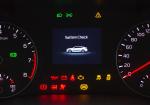
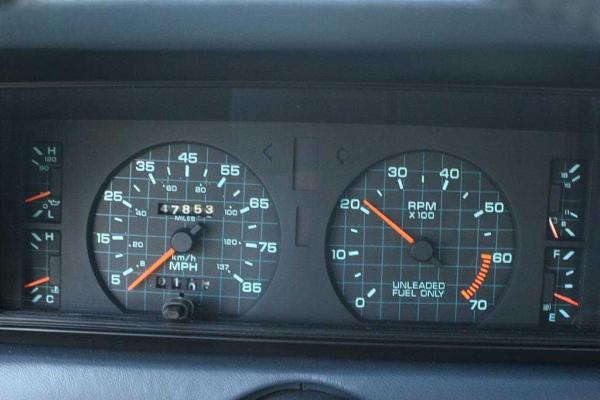
There is the dramatic driving position, a powerful engine and perhaps a body designed during an era when subtlety was taking a long lunch. Then comes the speedometer. The numbers climb with all the urgency of a family station wagon and finish at 85 mph.
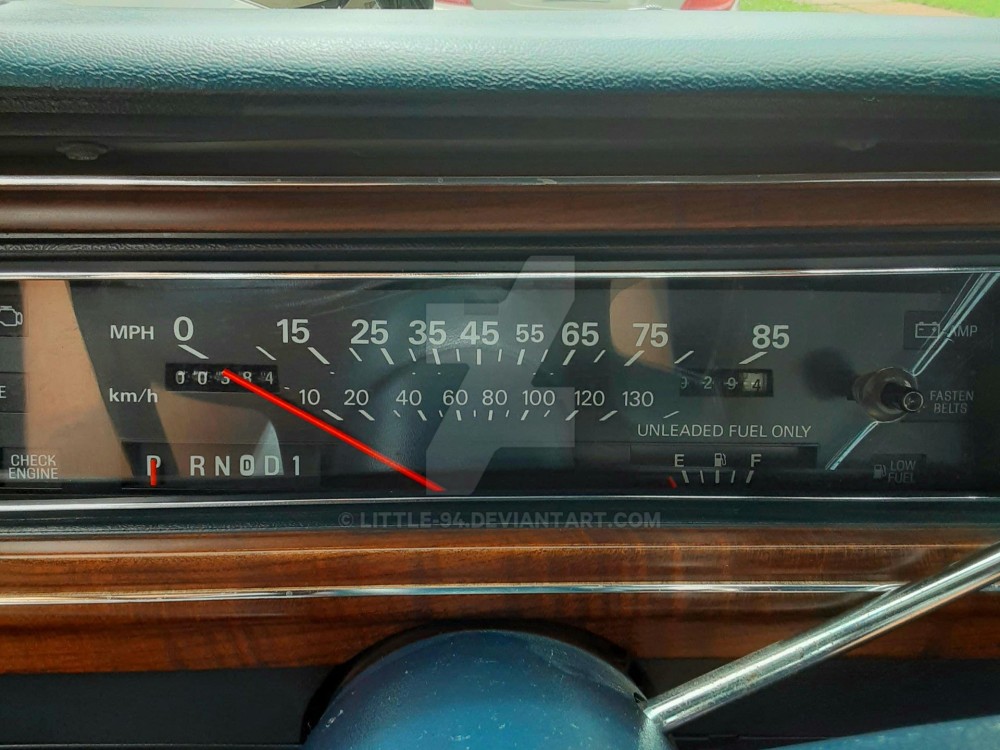
The car itself may be capable of considerably more. Its speedometer simply stopped discussing the matter.
This was no technical limitation, optimistic owner modification or cost-saving measure aimed exclusively at slower cars. For a brief period, the United States government decided that speedometers should discourage drivers from exploring the upper reaches of their vehicles’ performance.
America was trying to make 55 mph feel important
The story begins with the 1973 oil crisis. Fuel shortages, rising prices and concerns about national energy consumption changed the way American officials thought about driving.
In January 1974, President Richard Nixon signed legislation that led to a national maximum speed limit of 55 mph. Slower highway travel was meant to reduce fuel use, although safety benefits soon became part of the argument as well.
Road signs carried the new limit, but regulators also wanted the dashboard to reinforce it.
Federal Motor Vehicle Safety Standard 127 established requirements for speedometers and odometers. For speedometers, the particularly memorable section prohibited graduations or numerical values above 85 mph, equivalent to 140 km/h. The number 55 also had to receive special visual emphasis.
An official NHTSA interpretation from 1979 explained the thinking with unusual directness. The restricted display was intended to reduce the temptation to test a vehicle’s top speed and encourage compliance with the national 55-mph limit.
Somebody had effectively decided that a large number at the far end of a dial was an invitation.
The speedometer ended long before the performance did
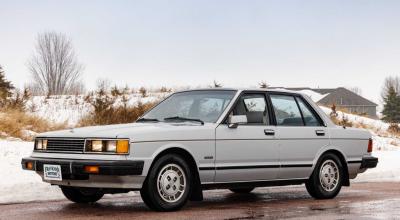
The requirement became effective on September 1, 1979, placing the 85-mph speedometer squarely in the dashboards of early 1980s cars.
It created some wonderfully awkward combinations. Performance models capable of comfortably exceeding the displayed maximum received the same basic limit as far less ambitious machinery. European manufacturers selling cars in the United States also had to adapt their instruments for the market.
The speedometer did not govern the engine, transmission or maximum road speed. Reaching the end of the scale caused no electronic intervention. Depending on the instrument design, the needle might simply arrive at its final marking, press against a stop or wander into an unmarked area where it could offer little more than an educated guess.
A car traveling beyond 85 mph had not run out of speed. It had run out of vocabulary.
Manufacturers had some freedom in presenting the scale, and collectors can find subtle differences between clusters. The required emphasis at 55 mph might take the form of a larger numeral, contrasting color, prominent dot or longer marking. On a dial containing relatively few numbers, the highlighted 55 often looks almost comically earnest.
Even advertisements adapted. During the period, some manufacturers promoted 0-to-50-mph acceleration because discussing performance up to the legal national limit sounded more respectable than boasting about speeds the dashboard had been designed to discourage.
The rule had a very short life
Changing a speedometer face was easy. Changing driver behavior proved less cooperative.
Federal regulators eventually reconsidered whether the restriction delivered meaningful safety benefits. The government revoked the original FMVSS 127 in 1982, with the repeal taking effect on March 25.
The reasoning was refreshingly practical. A speedometer ending at 85 mph had not shown convincing evidence of producing substantial safety gains. Highlighting 55 on the dial added little to the information already supplied by the large roadside sign carrying the same number.
The national 55-mph limit survived much longer. Congress permitted 65 mph on certain rural interstate roads in 1987, while federal control over maximum speed limits finally ended in 1995. By then, the 85-mph dashboard experiment had become a peculiar artifact of an earlier energy crisis.
Automakers did not all redesign their instruments the moment the rule disappeared. Product planning, existing parts and model-year schedules meant some cars retained the limited scale after the legal requirement had gone. Others quickly returned to three-digit speedometers, especially when a larger number suited the car’s image.
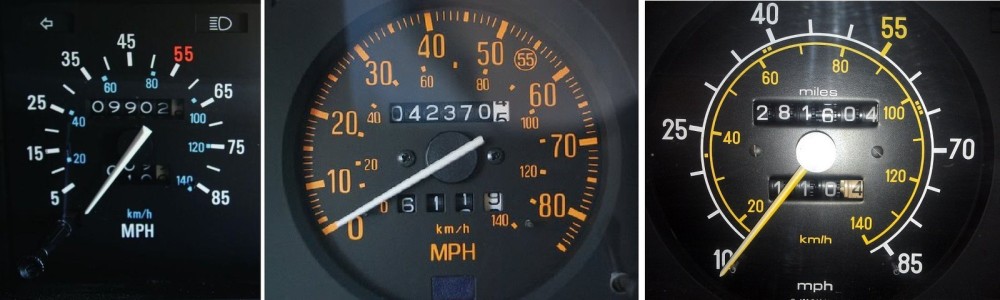
An 85-mph gauge can be completely original
Today, the speedometer can confuse buyers inspecting an early 1980s classic. A sports car with an 85-mph dial may appear to have received a cluster from a cheaper model, or an owner may assume that its instrument was replaced during an earlier repair.
Often, the modest gauge is exactly what the factory installed.
That matters because replacing a complete speedometer can complicate the mileage history. Mechanical odometers were commonly integrated into the same assembly, so swapping the embarrassing 85-mph unit for a more exciting version could also change the displayed distance.
Anyone buying a car from the period should compare the cluster with model-year documentation, service records and market specifications. American and European versions of the same car may have very different dials, and production changes do not always line up neatly with the date printed on the registration document.
The 85-mph speedometer remains one of the more charming examples of policy reaching directly into automotive design. Regulators wanted to make high speed psychologically less inviting. Manufacturers complied, drivers continued driving and some very fast cars spent a few years pretending that 85 mph was the end of the known world.