
The Seatbelt That Chased You Across the Door Was America’s Cheaper Alternative to an Airbag
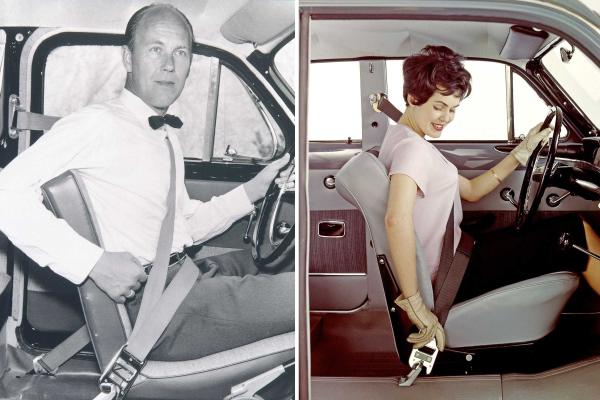
by AutoExpert | 9 September, 2026
Open the door of certain 1980s or early 1990s cars and a small buckle begins travelling along the roofline. Sit down, close the door and the shoulder belt glides toward the B-pillar, hopefully passing over the occupant rather than catching hair, glasses or an unfortunate earring along the way.
The car has buckled part of the seatbelt by itself.
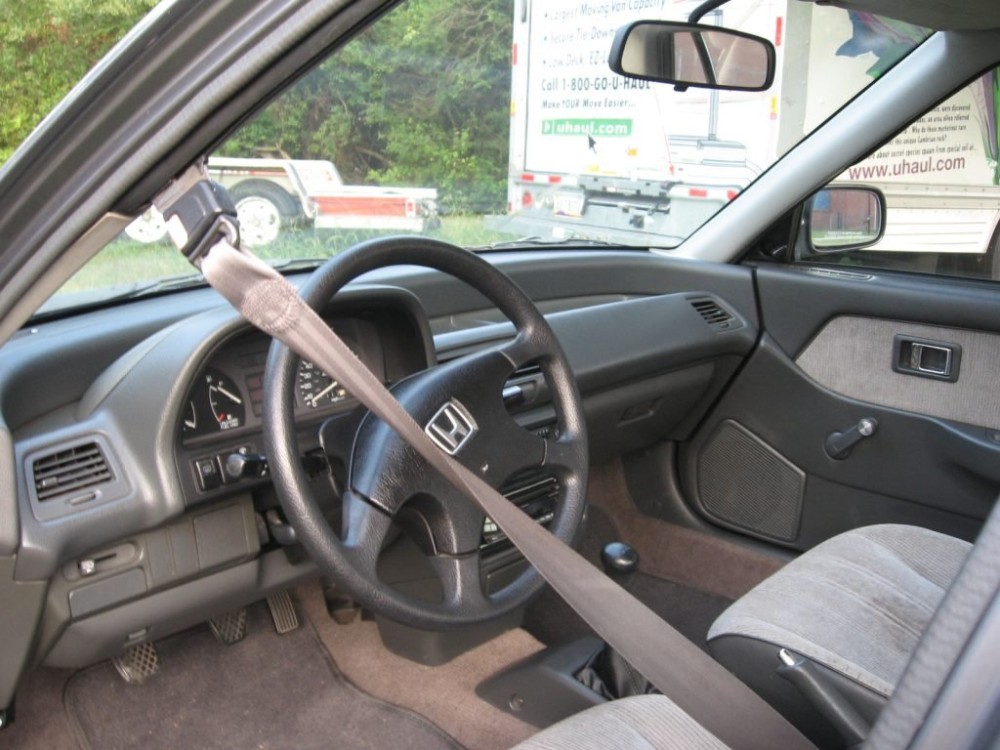
Motorized belts appeared in models from Toyota, Honda, Nissan, Mitsubishi, Ford, General Motors and several other manufacturers. For a brief period, they looked like the future of occupant protection.
Then they vanished almost as quickly as they had arrived.
Their rise had little to do with customers requesting a belt that moved around the cabin on a powered track. Automatic seatbelts were born from a long political and regulatory struggle over how to protect people who refused to buckle up.
Seatbelts worked beautifully when people used them
By the 1970s, the safety value of seatbelts was well established. Usage remained frustratingly low in the United States.
Many drivers found belts uncomfortable, inconvenient or unnecessary. Some tucked them into seats. Others sat on top of them, clipped them behind their backs or ignored them completely.
Regulators tried warnings and ignition interlocks. The 1974 model year brought systems that could prevent a car from starting until the front occupants buckled their belts. Drivers hated them, reliability problems followed and Congress quickly restricted the government’s ability to require such interlocks.
Attention shifted toward passive restraints, equipment that could protect an occupant without requiring a deliberate action before every journey.
Two principal technologies could perform the job: airbags and automatic seatbelts.
Airbags were expensive, unfamiliar and surrounded by engineering questions. Manufacturers worried about accidental deployment, long-term reliability and possible injuries to occupants sitting too close to the dashboard.
Automatic belts offered a more familiar solution. Take an existing seatbelt, attach part of it to the door or place it on a motorized rail, and allow the vehicle to move it around the occupant.
Federal regulators spent years issuing, delaying, revoking and defending passive-restraint requirements. A 1984 rule eventually required manufacturers to phase passive protection into new passenger cars beginning with the 1987 model year.
The rule did not demand airbags specifically. A compliant automatic belt could satisfy the requirement, and it was generally cheaper to develop.
America soon entered its motorized-seatbelt period.
Some belts moved, while others came attached to the door
Automatic seatbelts arrived in several forms.
The version most people remember used a shoulder belt attached to a small powered carriage. Opening the door moved the attachment point toward the windshield, creating space to enter. Closing the door sent it rearward along a track above the window, drawing the belt across the chest.
Another design mounted the shoulder and lap belt directly to the door. The occupant could enter without unbuckling because the entire belt moved outward with the door. Closing the door positioned it around the body.
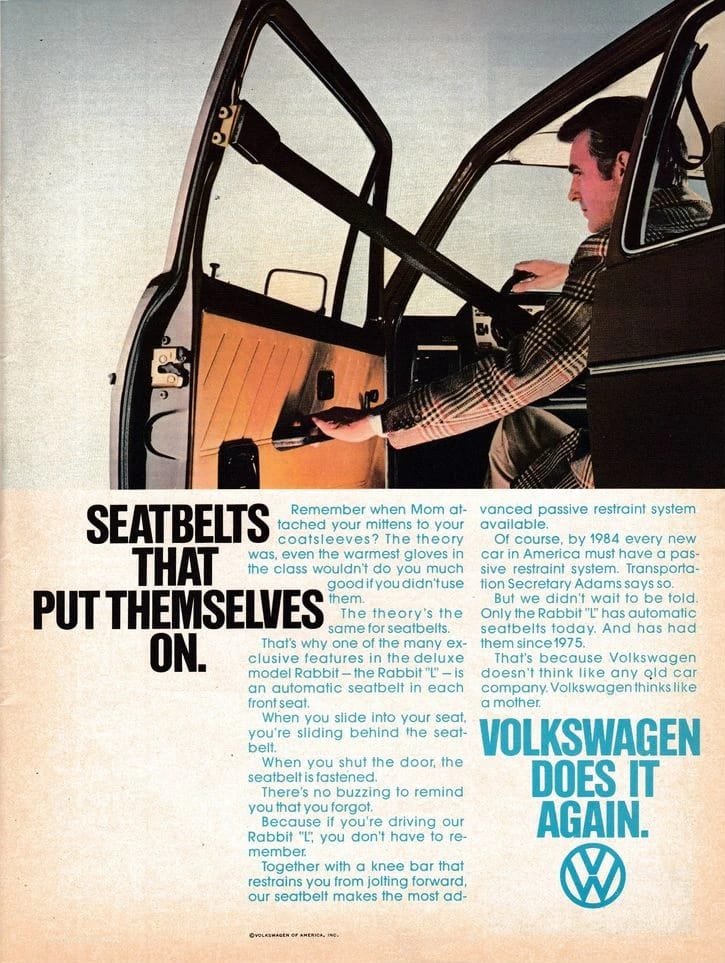
Both systems technically provided restraint without requiring the usual reach, pull and click.
Convenience depended heavily on the design and the person using it.
Motorized tracks added switches, wiring, gears and electric motors to a device that had previously needed none. An aging mechanism could become slow, noisy or stuck halfway along its journey. Owners sometimes disconnected troublesome belts, defeating their entire purpose.
Door-mounted designs avoided the motor and rail but created different concerns. Their geometry depended on the closed door, and occupants frequently unbuckled them through habit anyway.
Many motorized shoulder belts also required a separate manual lap belt. The automatic portion crossed the chest, creating the impression that the job was finished. Leave the lap belt unused and the body could slide beneath the shoulder belt during a collision, a dangerous movement known as submarining.
The National Academies’ review of seatbelt technologies notes that passive belts increased usage, although the systems proved cumbersome and experienced reliability problems. Research also identified injury concerns when automatic two-point shoulder belts were used without their accompanying lap belts.
The car could move a buckle. It could not force the occupant to finish the process correctly.
Airbags gradually won over buyers and manufacturers
Automatic seatbelts arrived because airbags were an alternative, expensive path to the same regulatory goal. Over the following years, airbags became a selling point rather than an engineering threat.
Manufacturers gained real-world experience. Sensors, inflators and control systems improved. Customers began associating airbags with more advanced and valuable safety engineering.
An airbag also worked comfortably alongside a conventional three-point manual belt. The belt held the occupant in the correct position and managed much of the crash energy, while the airbag reduced contact with the steering wheel, dashboard and other hard surfaces.
The two technologies worked better together than as competitors.
Automatic belts developed an image problem at the same time. Buyers disliked ducking under them. Repairing a failed track could be expensive. Used cars appeared with disconnected motors, broken guides and shoulder belts permanently parked beside the windshield.
Some systems would continue operating every time the door opened, faithfully dragging themselves forward and backward long after the novelty had worn off.
Federal legislation passed in 1991 ultimately required frontal airbags for the driver and front passenger in new passenger vehicles, with the requirements fully phased in later in the decade. Once airbags became unavoidable, manufacturers had little reason to preserve the complicated automatic belt.
Conventional manual three-point belts returned, now equipped with pretensioners, force limiters and improved anchorage geometry. They were simpler, less intrusive and more effective when worn correctly.
By the end of the 1990s, the moving shoulder belt had largely disappeared from new-car showrooms.
Owning one today requires a little extra attention
Automatic belts remain part of life with many surviving Japanese and American cars from the period. A functioning system adds enormous period charm, along with the faint possibility of being struck near the temple by a buckle.
Owners should resist the temptation to disconnect a troublesome track and continue using only the lap belt. The restraint system was designed and tested as a combination, and removing one section can leave the occupant seriously underprotected.
Replacement components can be difficult to find. Motors, cables, limit switches and track assemblies may no longer be available new, making specialist repair or used parts necessary.
Some automatic seatbelt components were covered by unusually long manufacturer warranties, recalls or service campaigns, depending on the model and market. An owner dealing with a failed system should check the vehicle identification number, manufacturer information and current recall database before paying for repairs.
The belt path also deserves inspection. Frayed webbing, damaged mounting points or a carriage that fails to reach its locked position can compromise protection even if the motor still makes all the correct noises.
Automatic seatbelts occupied a peculiar middle chapter in automotive safety. They increased restraint use and allowed manufacturers to meet passive-protection rules while airbag technology matured. They also created an elaborate mechanical answer to a task that a simple buckle already performed very well.
For drivers who remember them, the sound is unforgettable: door closes, motor hums and the belt begins its slow journey past the ear.
The future of car safety arrived on a track. It stayed for about a decade, then quietly drove away.