Rubber Is Naturally Pale, So Why Did the Automotive World Make Every Tire Black?
by AutoExpert | 11 September, 2026
A bright red car, a metallic blue car and a taxi painted the color of a highlighter will normally leave the factory with exactly the same footwear. Black tires. The color seems so inevitable that it is tempting to assume rubber simply emerges from a tree looking ready for a wheel. It does not. Natural latex is a milky fluid, and processed natural rubber is generally pale cream or beige.
Early tires reflected that. Old photographs occasionally show cars wearing wheels surrounded by light-colored rubber, an appearance that can make even a serious Edwardian motorcar look as though it has borrowed its tires from an enormous baby carriage.
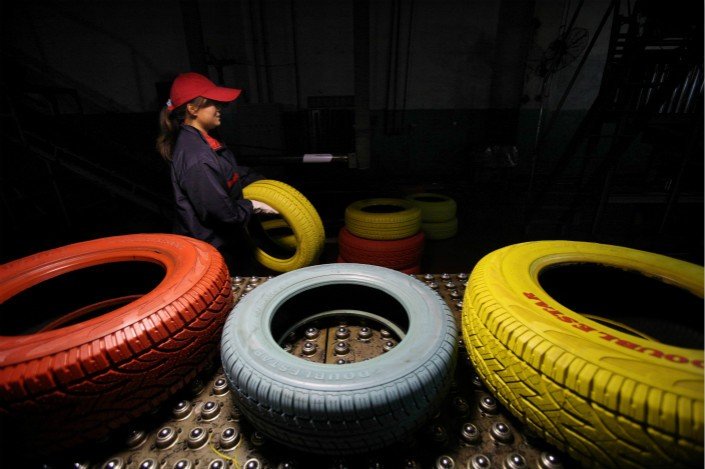
The switch to black was not primarily a styling decision. Tire manufacturers discovered that one particular ingredient could make rubber survive a much harder life. Its color happened to be impossible to miss.
Untreated rubber was never going to enjoy modern roads
A tire has a deeply unreasonable job.
A comparatively small ring of rubber must carry the weight of a vehicle, flex thousands of times during every journey, transmit acceleration and braking forces, absorb bumps, resist cuts and remain useful across a broad range of temperatures. It must also provide grip while surrendering as little energy as possible to rolling resistance.
Plain rubber cannot handle that list particularly well.
Vulcanization, the use of heat and sulfur to improve rubber’s strength and elasticity, made durable tires possible. Manufacturers then experimented with fillers and other ingredients to tune the material further. Zinc oxide was among the compounds used in early tire rubber, contributing to the pale or white appearance seen on period cars.
The larger breakthrough came from carbon black, a fine industrial form of carbon produced through the controlled partial combustion or thermal decomposition of hydrocarbon materials.
Carbon black sounds like pigment because it is used as one. Inside a tire, coloring the rubber is almost incidental.
According to Michelin’s guide to tire materials, carbon black began appearing in tire compounds around 1915 and could increase resistance to wear tenfold. Michelin says it may represent roughly 25 to 30 percent of a rubber compound, depending on the formulation.
That is much more than a splash of dye.
Carbon black earns its place in the mixture
Tiny carbon-black particles interact with the rubber and reinforce it. The resulting compound can better resist abrasion, tearing and the constant deformation produced as the tire rolls.
It also deals with two enemies that are difficult to see.
The first is heat. Tires generate heat as their rubber flexes and meets the road. Excessive temperature accelerates deterioration and can weaken the structure. Carbon black helps manage heat within the tread and belt area, reducing the damage caused by repeated thermal stress.
The second is sunlight. Ultraviolet radiation can attack rubber, contributing to fading, hardening and surface cracks. The International Carbon Black Association lists ultraviolet stabilization among the material’s important uses. The black compound absorbs and converts ultraviolet energy, helping protect the rubber beneath.
A black tire also hides brake dust, mud and road grime rather well, but cleanliness was never the breakthrough. If appearances were all that mattered, the industry could have settled on a color that made every curb mark somebody else’s problem.
Performance made the decision.
Once carbon black was mixed into tire rubber, the resulting black was so strong and uniform that it became the product’s natural appearance. As cars grew faster and heavier, returning to fragile pale rubber would have been a peculiar form of nostalgia.
Whitewalls preserved a piece of the old tire
The arrival of carbon black did not make every tire completely black overnight.
Manufacturers initially used the valuable reinforced compound where it mattered most: in the tread contacting the road. The sidewalls could remain pale, producing a black tread bordered by white rubber.
Eventually, fully black tires became common. By then, however, the contrasting sidewall had developed a style of its own. Manufacturers deliberately preserved a white strip, creating the whitewall tire associated with formal luxury cars, early hot rods and an age when cleaning wheels apparently counted as weekend entertainment.
Wide whitewalls became particularly fashionable during the 1930s, 1940s and 1950s. As cars became lower and styling grew sleeker, the bands narrowed. By the 1960s and 1970s, a thin white or colored stripe could provide the effect without visually enlarging the tire.
Raised white lettering used another version of the same contrast. A white rubber layer sits beneath a black outer surface, with the letters exposing the lighter material.
Modern specialty manufacturers still produce whitewalls, redlines and tires with colored details. Making an entire road tire in a bright color is also technically possible. The challenge is preserving the correct combination of wear, grip, heat resistance, weather protection, manufacturability and price.
Rubber chemistry is a balancing act. Replacing a proven filler simply to change the appearance may affect several other characteristics at once.
Modern tires use far more than carbon black
Calling a tire black rubber understates what is inside it.
A modern tire may contain natural and synthetic rubbers, steel, textile fibers, sulfur, oils, resins and numerous chemical agents. Michelin says more than 200 materials and components can be involved in a tire’s construction and formulation.
Silica has also become an important reinforcing filler. Properly combined with synthetic rubber and bonding agents, it can help reduce rolling resistance while maintaining useful wet grip. That improves fuel economy in combustion cars and extends driving range in electric vehicles.
Silica has not caused black tires to disappear. Compounds vary across the tread, sidewall and internal structure, and carbon black remains valuable for reinforcement, durability and protection. Decades of manufacturing knowledge have also been built around it.
The black surface therefore reveals surprisingly little about the complexity beneath. Two tires with nearly identical appearances may use very different compounds and behave differently in rain, cold weather, high-speed driving or ordinary wear.
Color is one of the few things they share.
So, why are tires black? Partly because carbon black is black, but mostly because it made tires dramatically better at being tires. The automotive industry kept the color because the material behind it proved strong, durable and difficult to replace.
Hiding dirt was merely a convenient bonus.