
The Man Who Invented Cruise Control Could Not See the Road
by AutoExpert | 8 September, 2026
Every passenger knows the type of driver. Conversation begins, the accelerator relaxes and the car gradually slows. The driver starts speaking, enthusiasm builds and the speed rises again. Nothing dangerous may happen, yet the repeated surge and retreat soon becomes impossible to ignore.
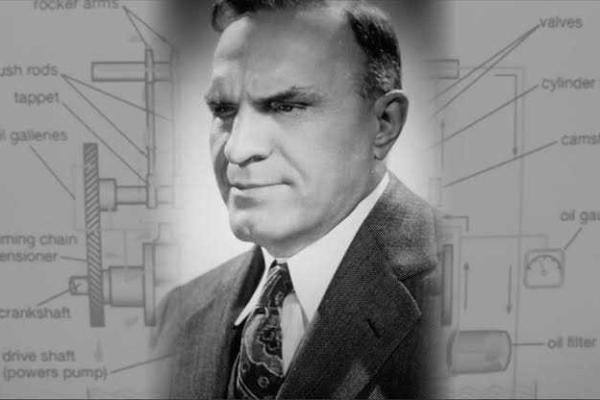
During the 1930s, one particularly inconsistent driver had Ralph Teetor sitting beside him. Teetor could not watch the speedometer because he had been blind since childhood. He could certainly feel every change in pace.
The driver was Harry Lindsey, Teetor’s friend and patent attorney. According to the National Inventors Hall of Fame, Lindsey tended to slow down while listening and accelerate when he started talking.
Teetor found the habit irritating enough to invent a solution.
The mechanism he developed evolved into modern cruise control, a feature now so ordinary that drivers engage it without giving much thought to the engineer behind it. Teetor’s own story was anything but ordinary.
He learned to understand machines through touch
Ralph Teetor was born in Hagerstown, Indiana, in 1890. An accident involving a knife severely injured one eye when he was five. A condition known as sympathetic ophthalmia later affected the other, and he eventually lost his sight completely.
His interest in mechanical objects survived.
Teetor grew up around the family business that became the Perfect Circle Corporation, a major producer of piston rings. Relatives taught him how to use tools and machine components. At 12, he and a cousin built a small automobile capable of reaching approximately 12 mph.
He later studied mechanical engineering at the University of Pennsylvania, graduating in 1912. Finding employment presented an obvious obstacle in an era when many employers struggled to imagine a blind engineer working around industrial machinery.
Teetor built his career anyway.
At Perfect Circle, he developed a remarkable ability to judge components through touch and vibration. Colleagues recalled him identifying tiny dimensional errors with his fingers, then proving correct when measuring instruments were brought over.
His sensitivity to vibration also became valuable when balancing rotating components. Machinery has a language of movement, texture and sound, and Teetor had spent much of his life becoming fluent in it.
The United States Patent and Trademark Office’s account of his career describes an engineer who worked on piston rings, turbine components and other precision equipment before creating his most famous invention.
Cruise control came from the same understanding of mechanical behavior. A vehicle’s changing speed could be detected, compared with a selected setting and corrected without asking the driver’s right foot to achieve perfect consistency for hours.
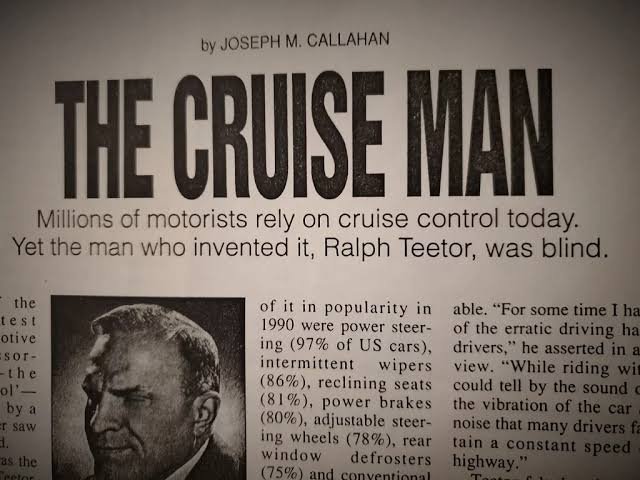
The first version had no radar or cameras
Teetor began developing his speed-control device during the 1940s and filed a patent application in 1948. U.S. Patent No. 2,519,859 was granted in 1950.
The system was entirely mechanical. A speed selector allowed the driver to choose a desired pace, while a governor responded to the rotation of the drivetrain. The mechanism interacted with the accelerator control to prevent the vehicle from continuing beyond the selected speed.
Teetor refined the idea through several versions. Names including Controlmatic, Touchomatic and Speedostat were considered or used during its development. Speedostat became the best-known early product name.
The basic problem was more complicated than holding the throttle in one position. A fixed throttle opening cannot maintain the same speed on changing terrain. A car requires more power while climbing and less while descending.
An effective speed-control system must notice the difference and adjust accordingly. Teetor’s invention created the foundation for that feedback process using mechanical parts rather than electronic sensors and software.
Perfect Circle manufactured the production system, and Chrysler became the first automaker to offer it. The 1958 Imperial, New Yorker and Windsor could be ordered with the feature under Chrysler’s wonderfully ambitious name: Auto-Pilot.
No steering or braking occurred automatically. The driver remained responsible for nearly everything, but “Auto-Pilot” probably sounded more exciting in a showroom than “device that prevents Harry Lindsey from varying his speed during conversation.”
Cadillac introduced the technology under the name Cruise Control for 1959. That description stuck.
A convenience feature became part of automated driving
Early cruise control belonged mainly to expensive cars. America’s long highways made the appeal obvious. Once the desired speed was selected, the driver could relax the accelerator foot and allow the system to make small throttle adjustments.
The benefits extended beyond comfort. A steady speed could reduce unnecessary acceleration and help drivers avoid drifting far above the limit. Results for fuel consumption depended on the road, traffic and driver behavior, just as they do today.
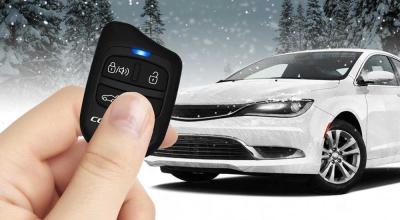
Electronic controls gradually replaced the mechanical governor. Vehicles gained the familiar steering-wheel buttons for setting, resuming and adjusting speed. Later systems began reading the road ahead.
Adaptive cruise control uses radar, cameras or both to monitor traffic and adjust speed when a slower vehicle enters the lane. Some versions can bring the car to a stop and resume moving in congestion.
Modern hardware would have appeared extraordinary beside Teetor’s original mechanism, although the central task remains recognizable. The vehicle observes a changing condition, compares it with the driver’s chosen target and makes a correction.
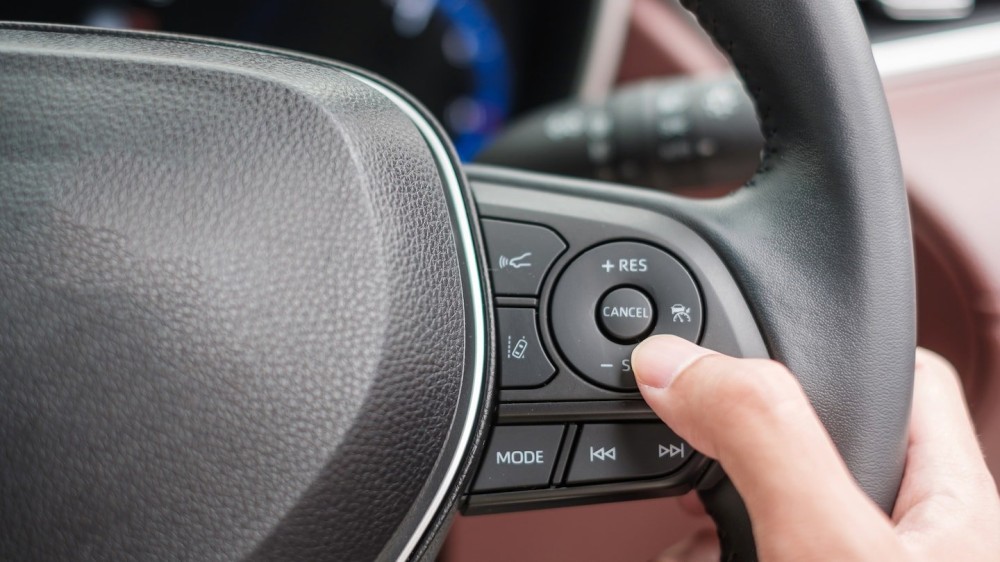
Cruise control does not make a car autonomous, and the driver must remain alert even when an advanced system manages speed and following distance. Teetor understood the value of assistance rather than replacement. His invention relieved one repetitive part of driving while leaving judgment in human hands.
He died in 1982, having served as an executive at Perfect Circle and contributed numerous inventions to the automotive industry. The Automotive Hall of Fame inducted him posthumously in 1988, and the National Inventors Hall of Fame followed in 2024.
Millions of drivers now use cruise control because a blind passenger could feel every time his friend became too interested in a conversation.
Harry Lindsey’s wandering speed may have tested Teetor’s patience. The cure outlived them both.