
That Tiny Hole in Your Muffler May Be There on Purpose
by AutoExpert | 30 July, 2026
Finding a hole in the exhaust usually leads to one conclusion: the muffler is rusting away and the bank account is about to become involved.
That conclusion is often correct. Exhaust systems live a thoroughly unpleasant life underneath a car, where they are heated, cooled, soaked, salted and occasionally introduced to speed bumps with unnecessary enthusiasm.
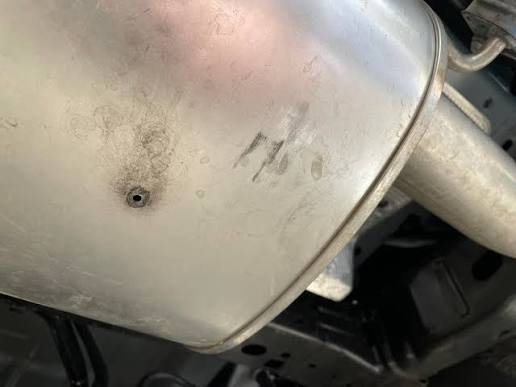
But a tiny, clean hole at the lowest point of a muffler may not be damage at all. It may have been placed there deliberately.
Engines produce water. Not because something has gone wrong, but because water vapor is one of the normal products of burning fuel. When the exhaust system is hot, much of that vapor leaves through the tailpipe unnoticed. When the system is cold, some of it condenses inside the pipes and mufflers.
This is why a car may drip clear water from the tailpipe after startup. It is also why short journeys are hard on exhaust systems. A ten-minute drive may warm the engine, but it does not always keep the entire exhaust hot for long enough to evaporate the moisture collecting farther back.
Switch the engine off, let the metal cool and some of that water remains behind.
A muffler is not simply an empty metal box. Inside are chambers, tubes and baffles designed to take the harsh pulses leaving the engine and turn them into a sound acceptable to neighbors, passengers and local noise regulations. Those internal shapes can also create low spots where condensation gathers.
A weep hole gives that water somewhere to go.
It is usually small, neat and positioned at or near the bottom of the muffler or exhaust pipe. There may be a little staining around it, and an occasional drip is not unusual. What it should not resemble is a torn edge, a spreading rust blister or a hole surrounded by metal thin enough to crumble under light pressure.
Factory service information confirms that deliberate exhaust drains are real, not folklore invented by someone trying to avoid buying a new muffler. In 2020, Stellantis issued a bulletin for several Jeep and Fiat models instructing technicians to add a 3 mm weep hole to the muffler. Condensation could freeze inside certain affected vehicles and contribute to a no-start condition.
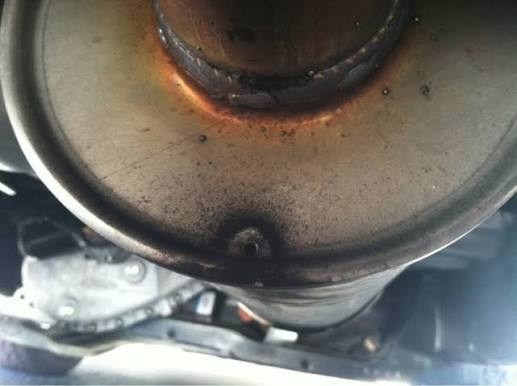
General Motors has published similar model-specific instructions involving a small drain hole at a low point in an exhaust pipe where water could collect.
That does not mean every small muffler hole is intentional.
A genuine drain tends to look almost too tidy to be rust. It is round, deliberately located and often appears in a sensible drainage position. Corrosion has less respect for geometry. Rust damage usually brings rough edges, flaking metal, swelling seams and brown staining across a wider area. Several pinholes may appear together, particularly around welded seams or the ends of the muffler.
Sound provides another clue. A rust hole often makes the exhaust note louder, rougher or more hollow. There may be a sharp puffing noise that follows engine speed, especially when the car starts cold. Black soot around the opening suggests exhaust gases are escaping there in meaningful quantity.
A tiny drain can still release a trace of moisture and exhaust, so location and construction matter more than one clue by itself.
Smell matters too. Exhaust fumes entering the passenger compartment are never something to explain away as “probably the little drain.” A leaking exhaust can allow carbon monoxide into the vehicle, particularly if the damaged section is beneath the cabin. If fumes are noticeable inside, stop treating the issue as an interesting inspection mystery and have the car checked promptly.
The temptation, after learning about weep holes, is to crawl underneath with a drill and improve the muffler personally. Resist it.
A manufacturer’s bulletin specifies the exact vehicle, location, hole size, drilling angle and depth. Drilling in the wrong place can damage internal components, create an unwanted exhaust leak or accelerate corrosion. It may also put the hole somewhere exhaust gases can affect nearby parts or enter the cabin.
Likewise, an existing drain should not be plugged merely because water comes out of it. Some heavy-vehicle service guidance explicitly warns that designated exhaust drains must remain open to prevent water damage.

If the hole is clean and clearly intentional, leave it alone. If it is ragged, growing, noisy or surrounded by crumbling metal, the muffler is asking for an inspection rather than admiration.
The distinction is rather satisfying. One hole means the exhaust is rusting through. Another, only a few millimeters wide and perhaps inches away, may be helping prevent exactly that.
Under a car, even a hole can be a feature.