
Your Front Brakes Do Most of the Work, So Why Did the Rear Pads Wear Out First?
by AutoExpert | 11 September, 2026
The usual explanation sounds perfectly logical. When a car slows down, its weight moves toward the front. The front tires carry more load, so the front brakes provide more of the stopping force. That is why cars generally have larger discs and calipers at the front and why front pads traditionally wear out first.
Then a technician calls to say the rear brake pads are nearly finished while the fronts still have plenty of material.
Nothing about that invoice appears to respect the physics lesson.
Rear brakes wearing faster than front brakes can indicate a problem, but the order alone does not prove that anything has failed. Brake systems have changed considerably since a simple hydraulic circuit divided most of the work between two large front discs and two modest rear drums.
Modern cars can apply individual brakes without the driver touching the pedal. They can vary the balance between the axles and hold the vehicle on a hill. The rear pads may also begin life considerably smaller than the fronts.
There is more happening behind the wheels than the brake pedal reveals.
Front brakes still handle the hardest stops
During strong braking, the vehicle’s center of gravity continues moving forward while the tires try to slow the body. The nose dips, the front suspension compresses and the rear axle becomes more lightly loaded.
More grip is available at the front, allowing the front brakes to perform a greater share of the work. If the rear brakes received the same pressure under those conditions, the lightly loaded rear wheels could lock before the fronts, making the car unstable.
Older vehicles controlled that risk with proportioning valves. Modern cars use electronic brake-force distribution, working with the anti-lock braking system to adjust pressure according to wheel speed, vehicle loading and available grip.
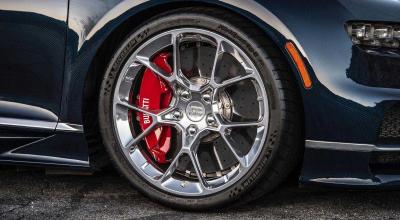
The larger front pads and discs are designed to absorb and release substantial amounts of heat during hard stops. Rear components usually have a quieter role.
Hard work per stop, however, is only one part of brake-pad life.
A smaller rear pad has less friction material available to lose. It may perform less work during each stop and still reach its replacement thickness before a much larger front pad. Comparing the percentages quoted on an inspection report can therefore be misleading. Fifty percent remaining does not represent the same amount of material at both ends of the car.
The car may use its brakes when the driver does not
Electronic stability control watches wheel speed, steering angle, lateral acceleration and the direction in which the car is actually moving. If the driver turns left but the vehicle begins sliding somewhere less helpful, the system can reduce engine power and brake selected wheels to bring the car back into line.
Bosch’s explanation of electronic stability control describes how the system applies individual brakes when reducing engine output is not enough. Depending on whether the car is understeering or oversteering, one of those interventions may involve a rear wheel.
Traction control can also brake a spinning drive wheel. Trailer-sway control, hill-descent control and certain lane-support systems may use the brakes for corrections that are barely noticeable from the driver’s seat.
The rear pads are not secretly stopping the car all day, and occasional stability-control intervention should not consume them at a dramatic rate. Over thousands of miles, however, these functions can contribute to a wear pattern that looks different from one produced by a much older car.
Driving conditions matter too. A vehicle used on slippery roads, tight bends or steep hills may call on its electronic helpers more frequently. A powerful rear-wheel-drive car that regularly flashes its traction-control light is effectively asking the rear brakes to tidy up after the accelerator.
That housekeeping leaves a receipt.
Adaptive cruise control is not automatically the culprit
When rear pads wear quickly, adaptive cruise control often receives the blame. The theory usually claims that the system uses only the rear brakes to regulate speed, quietly grinding them away whenever traffic slows.
There is no universal rule supporting that explanation.
Adaptive cruise systems vary by manufacturer and vehicle. They may reduce engine torque, downshift, use regenerative braking or request hydraulic braking through the main brake-control system. The distribution of that braking depends on the vehicle’s programming and conditions.
Bendix has specifically challenged the idea that adaptive cruise necessarily places greater demands on the brakes than an attentive driver. Smooth, gradual speed adjustments should not create extraordinary wear simply because a computer requested them.
The same caution applies to automatic hold features. Holding a stationary car with the rear brakes clamped does not meaningfully wear away pad material because the disc is not rotating. Trouble begins if the mechanism fails to release fully when the car moves.
Electronic systems can influence brake use, but they should not become convenient suspects for every worn pad.
The wear pattern often tells the real story
If both rear wheels have worn at a similar rate and the car brakes normally, the pattern may reflect the vehicle’s design, pad size and driving conditions. Checking service information and owner reports for the specific model can help establish whether rear-first replacement is common.
One worn rear wheel deserves more suspicion.
A disc-brake caliper must slide or move freely so that pressure reaches both pads evenly. Corrosion, dried lubricant or damaged slide-pin boots can prevent that movement. One pad may remain pressed against the disc after the brake pedal is released, wearing itself thin and generating unnecessary heat.
The difference between the inner and outer pad is particularly useful. If one is substantially thinner, the caliper, piston, slides or mounting hardware may be binding. Tapered wear can point to movement or alignment problems within the caliper assembly.
A deteriorated flexible brake hose can occasionally act like a one-way valve, allowing pressure into the caliper but preventing it from releasing promptly. The wheel may feel unusually hot after an ordinary drive, and the car can develop a burning smell or pull to one side.
Parking-brake hardware is another possibility because the mechanism usually operates at the rear. A corroded cable, sticking lever or electronic actuator that does not return fully can leave the brake dragging. The driver may never notice a dramatic loss of performance, only a slight reduction in fuel economy and a rear pad that seems to have led a very short life.
Replacing the pads is only half the repair
New pads will not cure a seized slide pin or dragging parking brake. They will merely provide fresh material for the same fault to destroy.
Before replacing prematurely worn rear pads, the technician should compare all four pads, inspect the disc surfaces and confirm that the calipers release correctly. Slide pins, boots, mounting hardware and parking-brake operation deserve attention. Diagnostic trouble codes may also reveal repeated stability-system interventions or an electronic parking-brake fault.

Wear should be judged in millimeters and by pattern, not only by a vague remaining-life percentage.
If the rear pads have worn evenly and the vehicle manufacturer considers that normal, there may be nothing more sinister than modern brake calibration and smaller components. If one side or one pad is much thinner, the car is providing a useful clue.
Front brakes still do most of the heavy lifting. Rear pads can simply reach the finish line first, unless something has been quietly dragging them there.