
Is Mobility as a Service (MaaS) the Future of Urban Transportation?
by AutoExpert | 18 March, 2025
Mobility as a Service could change how we think about getting around - but is ditching your own wheels really the way forward?
Remember when owning a car was just... normal? These days, everything about our relationship with four wheels is changing fast. We've swapped hatchbacks for chunky SUVs, and we're slowly ditching petrol pumps for charging points. But the biggest shift might not be what we drive – it's whether we'll own cars at all.

Enter MaaS – Mobility as a Service. Sounds fancy, right? In simple terms, it means buying "mobility" rather than an actual vehicle. Think of it like how we consume movies now. Nobody's rushing to HMV to buy DVDs anymore; we just tap Netflix and watch whatever we want, whenever we want. That same shift could be coming to cars.
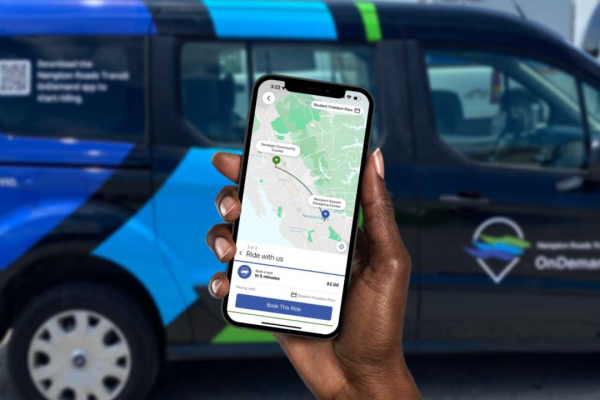
Car-sharing services are popping up everywhere, letting you grab a nearby vehicle with just a few taps on your phone. Apps like Hiyacar and Zipcar show available cars in your area that you can walk up to, unlock with your phone, and drive away. No ownership hassles, no massive upfront costs.
Now, you might be thinking: "Why would I faff around finding and renting a car when I could just walk outside and hop in my own?" Fair question. But there are some pretty compelling benefits to this whole sharing thing.
For starters, it's better for the planet. Fewer cars on the road equals less pollution – simple math. And the research backs this up. A 2014 study in Paris showed people using car-sharing services reduced their vehicle ownership by 23%. A more recent study across Europe found between 14.3% and 40% of people ditched their personal cars after trying sharing schemes.

Of course, it's not all rosy. A study from South Korea found car-sharing actually pulled people away from even greener options like walking, cycling and public transport. And let's be honest – with the state of UK public transport these days, it's easy to see why people might prefer the privacy of a car, shared or not.
Still, these sharing services typically use newer, cleaner vehicles. UK transport charity CoMoUK found the average car-sharing vehicle pumps out 27% less CO2 than privately owned cars. Research from Finland's University of Oulu suggests that switching sharing fleets to low and zero-emission vehicles could slash carbon output by up to 31%.

The reality is that not everyone can drop £30,000+ on a new electric car or has somewhere to park it, especially in busy cities. That's where these sharing services and subscriptions become really appealing. Car manufacturers are catching on too, with a wave of affordable EVs designed specifically for city mobility and sharing fleets.
Take the Mobilize Duo, for example. It's the first UK offering from Renault Group's mobility-focused brand, which has been operating car-sharing services across Europe since 2021. Speaking to Auto Express, Mobilize's mobility business director Léo Brouette said they're "studying the potential to bring a car-sharing scheme to the UK," with the Duo designed specifically with fleet operators in mind.

The Duo comes loaded with tech that makes it perfect for sharing. It has geofencing as standard, so fleet operators can control exactly where the car can go. Unlike Citroen's Ami quadricycle which uses an old-school key, the Duo unlocks and starts with your phone – even in underground car parks where signal can be patchy.
This means users can pay for a ride through an app, download a digital key, and simply walk up to the car – no need to pick up physical keys from an office somewhere. And being a tiny quadricycle, the Duo is perfect for short city trips and takes up way less space than a normal car. According to Mobilize, you can fit three Duos in a single parking space!
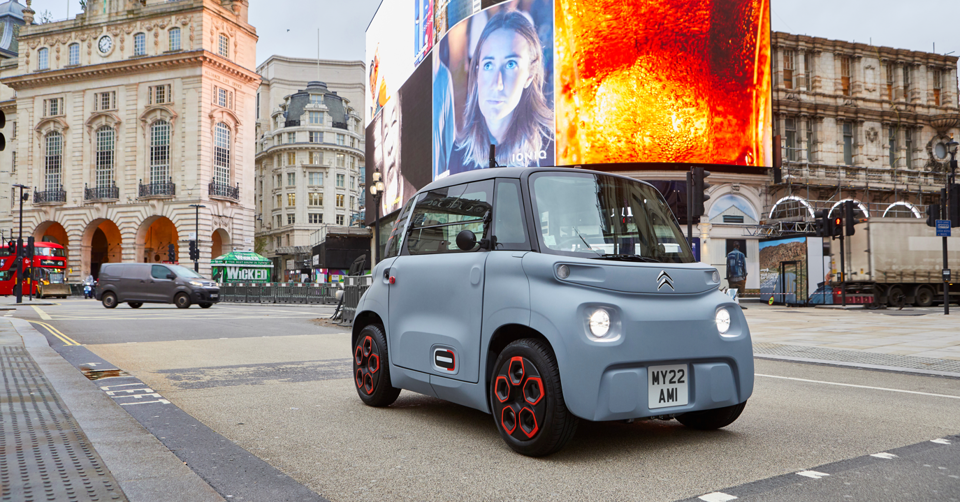
François Laurent, chief engineer at Mobilize, points out that "the Duo's tandem architecture is not a limitation. It keeps the car compact and easy to park." Even better, in some European countries, certain quadricycles like the Ami and some Duo versions can be driven from age 14 without a license, massively expanding the potential user base.
There's an environmental upside to manufacturing these tiny vehicles too. Making a Duo produces 66% less CO2 than building a comparable electric city car like the Fiat 500e or Hyundai Inster. They're also cheaper and easier to repair – the Duo's front and rear bumpers are identical and 100% recyclable, as are the Ami's left and right doors.

Let's be real, though – MaaS solutions like car-sharing won't work for everyone. Finding an available vehicle in a busy city is one thing, but good luck doing that in the countryside. Car financing and ownership aren't disappearing overnight.
But sharing services are already gaining ground in the UK, and it seems inevitable that drivers will soon have access to a wide range of affordable rides. Traditional carmakers are eyeing this new market, leading to a fresh wave of vehicles and mobility options that might just change how we think about getting from A to B.
What's the Duo like to drive?
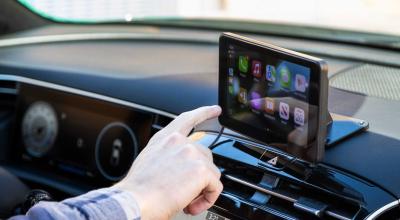
Unlock the Duo with your phone, snap it into the dashboard cradle and you're ready to roll. With just 16bhp on tap, it's no speed demon, but it gets up to 30mph without breaking a sweat – which is more than you can say for some rivals.

It's super nimble thanks to a tight 6.8-metre turning circle, even without power steering. The McLaren Senna-style glass doors give great visibility – perfect for navigating busy cities packed with cars and pedestrians. Pricier models even come with parking sensors, which is a godsend since rear visibility is non-existent when carrying a passenger.
It's not all smooth sailing, though. There's practically zero sound insulation, so you'll hear every whirr of the electric motor and all the street noise around you. And the manual handbrake is awkwardly positioned so far forward that you have to stretch to reach it – not ideal when you're trying to pull away at busy traffic lights.