
The First Crash-Test Dummy Had a Far More Terrifying Job Than Testing Cars
by AutoExpert | 8 September, 2026
Long before a crash-test dummy sat behind the wheel of a family sedan, one was strapped into an aircraft ejection seat.
Its assignment involved rocket sleds, aviation helmets and the violent forces produced when a pilot had to leave an aircraft in a tremendous hurry. Compared with that, being launched into a padded dashboard must have felt like a respectable career change.
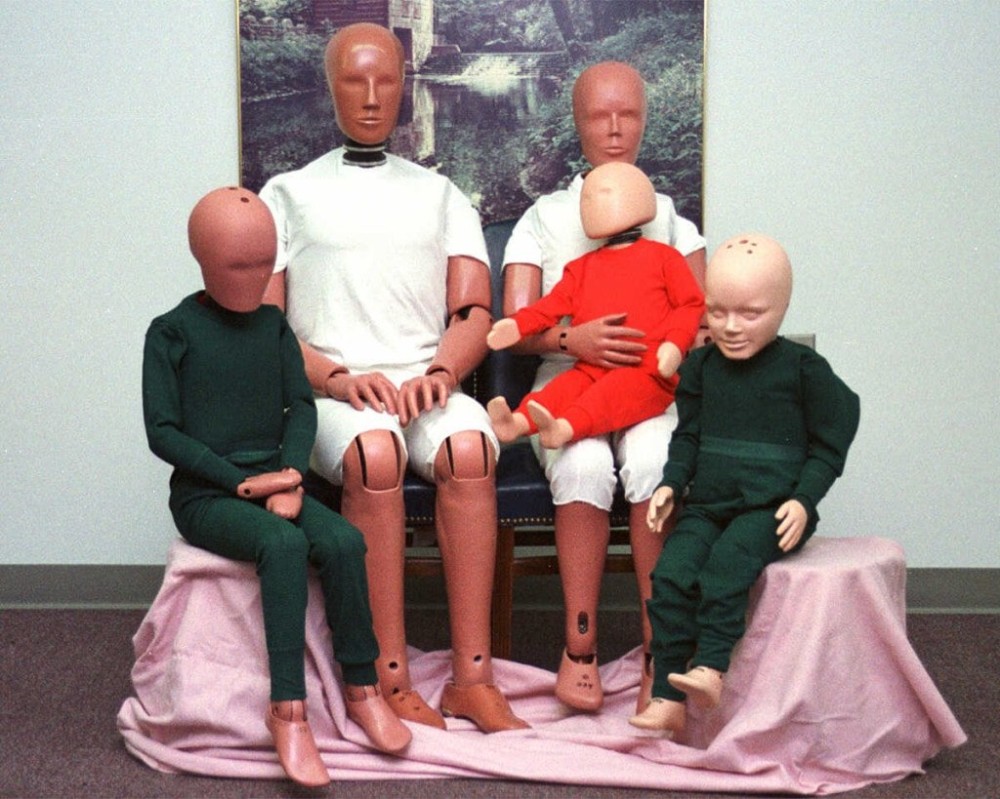
The dummy was called Sierra Sam. Developed in 1949 through work involving Samuel Alderson and Sierra Engineering, he became the ancestor of the instrumented figures now seen in automotive crash laboratories.
Sam did not begin life as a mascot or theatrical stand-in for a human body. Engineers needed a repeatable way to measure what extreme acceleration and deceleration did to a person.
The alternatives available at the time were limited, inconsistent and occasionally grim.
Safety research once relied on sandbags, bodies and brave volunteers
Early aviation tests sometimes used flour sacks or sandbags to place weight in an ejection seat. They could tell engineers whether the mechanism fired and whether the seat travelled in roughly the expected direction.
A sack could not explain what the launch might do to a spine, neck or rib cage.
Researchers also used animals, donated human bodies and living volunteers. Each approach produced valuable information along with serious limitations. Human anatomy varies considerably, cadavers cannot recreate every response of living tissue and volunteers can only be exposed to survivable forces.
A mechanical human substitute offered repeatability. Engineers could perform the same experiment several times, change one component and compare the measurements.
Sierra Sam represented a large adult man and was originally used for military and aerospace work. He helped researchers evaluate ejection seats, restraints and protective equipment without placing a living pilot in every test.
The Humanetics historical timeline credits Alderson Research Laboratories and Sierra Engineering with creating Sam in 1949. The aerospace dummy gradually inspired versions better suited to vehicle collisions.
Car crashes presented a different collection of injuries. An aircraft ejection test focused heavily on vertical acceleration and restraint forces. A vehicle occupant could strike the steering wheel, dashboard, windshield or door while experiencing loads from several directions.
The dummy had to become more human in the ways engineers could measure.
A useful dummy must be injured consistently
The word “dummy” makes the device sound simple. A modern anthropomorphic test device, the technical name used by engineers, contains carefully designed joints, metal structures, rubber components and electronic instruments.
Its job is to react consistently.
If two identical crashes cause the dummy’s neck to bend differently for no known reason, the results become difficult to trust. Every body part must therefore be manufactured, assembled and calibrated within strict limits.
The head may contain accelerometers that measure movement in several directions. Sensors in the neck record bending and stretching forces. The chest measures compression. Load cells in the legs reveal what happens when the knees and feet meet the dashboard or footwell.
Before a formal test, the dummy’s components are calibrated through controlled impacts and movements. Engineers already know how its head, chest or knee should respond to a defined force. A component that falls outside the permitted range must be adjusted or repaired.
The dummy also needs a repeatable seating position. Small changes in distance from the steering wheel, seatback angle or belt routing can influence the measurements. Preparing one for a crash involves far more care than dropping it into the driver’s seat and closing the door.
Samuel Alderson introduced his VIP series for automotive testing during the late 1960s. VIP stood for Vehicular Impact Personnel and included different body sizes.
General Motors later combined elements from Alderson and Sierra designs to create Hybrid I in 1971. The name came from that mixture of existing technologies rather than from any electrical assistance.
Hybrid II followed with improved construction and documentation. In 1973, it became the first crash-test dummy formally incorporated into the American federal standards governing anthropomorphic test devices.
Then came the familiar face of automotive crash testing.
Hybrid III became the industry’s most famous passenger
General Motors introduced Hybrid III in 1976 after improving the dummy’s neck, chest and measurement equipment. Its responses were designed to correspond more closely with biomechanical knowledge of human injury.
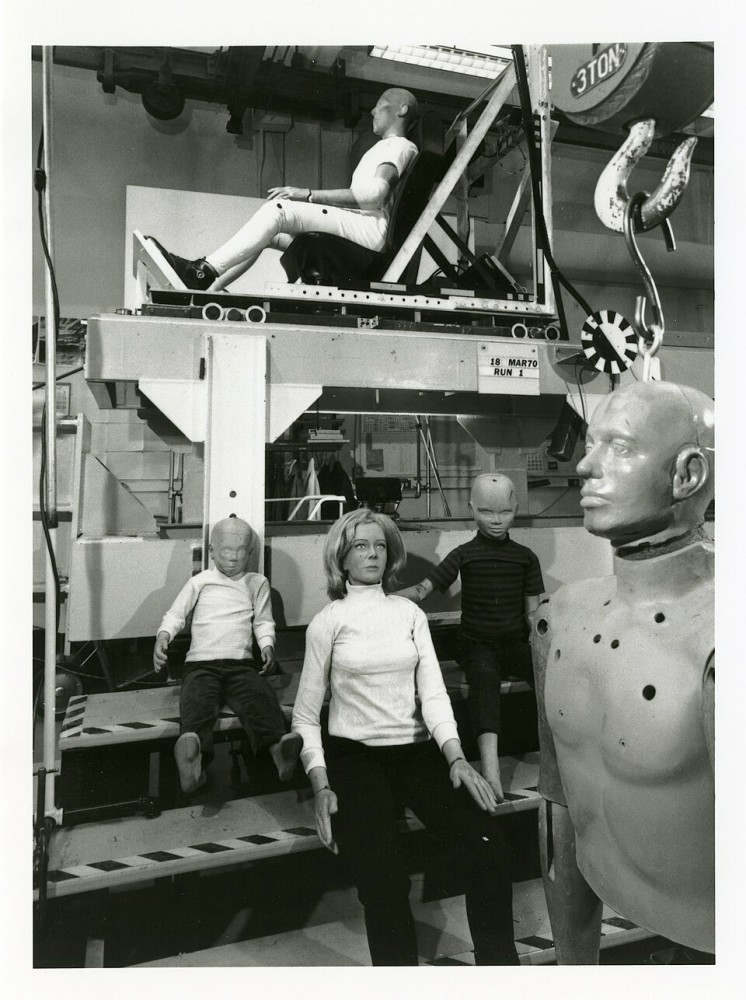
The best-known version represents a 50th-percentile adult male. According to NHTSA’s crash-test dummy guide, the figure is 5 feet 9 inches tall and weighs 171 pounds.
One body could never represent everyone inside a vehicle. NHTSA’s family of test devices also includes a small adult female, children of several ages and infant models used in child-restraint testing. Side-impact crashes require dummies designed differently from those used for frontal collisions.
Each model gathers information relevant to its particular test. A seatbelt, airbag or dashboard structure that protects a medium-sized adult may interact differently with a small passenger or child.
Physical dummies now work alongside computer simulations. Digital human models allow researchers to explore far more body shapes, seating positions and crash conditions than would be practical with a laboratory full of mechanical occupants.
Computer work has not made the physical dummy obsolete. Real vehicles still bend, tear and behave in ways that need to be observed under controlled conditions. The dummy provides measurements from inside that destruction.
Two dummies became unlikely television stars
Crash-test dummies eventually escaped the laboratory and entered popular culture.
In 1985, the U.S. Department of Transportation introduced Vince and Larry, two talking dummies used in advertisements encouraging seatbelt use. Their slogan, “You Could Learn a Lot From a Dummy,” accompanied a series of increasingly elaborate crashes.
The humor was broad, the collisions were memorable and the message was easy to understand. Vince and Larry could be crushed, disassembled and thrown through windshields without turning a public-safety advertisement into something viewers wanted to avoid.
NHTSA notes that the characters were eventually inducted into the Smithsonian’s National Museum of American History. A scientific instrument originally developed for military research had become one of America’s most recognizable road-safety symbols.
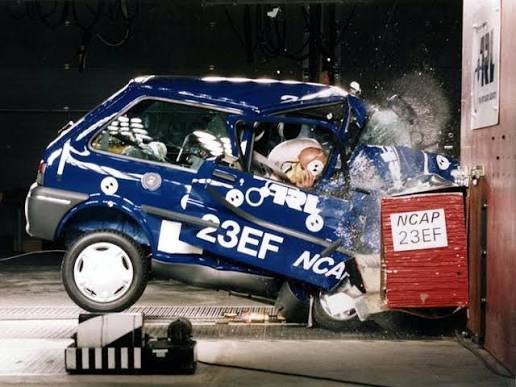
Real crash-test dummies receive less glamorous treatment. They are struck, inspected, repaired and calibrated repeatedly. Their painted faces remain expressionless while sensors record forces that would cause severe or fatal injuries to a human occupant.
Every result gives engineers another opportunity to alter a seatbelt, airbag, head restraint, dashboard or vehicle structure before people experience the same collision on a road.
Sierra Sam began with the problem of getting a pilot out of an aircraft alive. His mechanical descendants moved into cars and helped engineers understand what happens when occupants cannot get out at all.
They have endured thousands of carefully planned crashes so the rest of us can survive the unplanned ones.