
Your Steering Wheel Shakes at 65 MPH, but an Alignment May Waste Your Money

by AutoExpert | 10 August, 2026
The car feels perfectly normal around town. At 35 mph, nothing rattles. At 50, there may be the faintest tremor. Reach highway speed and the steering wheel begins a steady dance between the driver’s hands.
Slow down and it disappears.

That narrow speed range is a valuable clue. Many drivers respond by booking a wheel alignment, partly because alignment has become the catch-all cure for anything involving tires and steering. Yet a vibration that appears mainly at highway speed more often sends the investigation toward wheel balance.
Alignment and balancing solve different problems. Paying for the wrong one leaves the steering wheel shaking and the invoice annoyingly solid.
A small imbalance becomes a large nuisance at speed
A tire and wheel assembly is never perfectly uniform. One section may be fractionally heavier than another because of the tire, wheel, valve or manufacturing tolerances.
A balancing machine spins the assembly, measures where the uneven weight sits and tells the technician where to attach small counterweights. When everything is correct, the wheel rotates smoothly around its center.
Lose one of those weights and the imbalance may be impossible to notice at low speed. As the wheel spins faster, the uneven force becomes stronger. The suspension begins receiving a repeated tug with every rotation, and the driver feels it as vibration.
Michelin lists steering-wheel vibration at highway speeds as a classic sign of wheel-balance trouble.
An alignment deals with the angles at which the wheels sit and point. Incorrect toe, camber or caster can make the car pull, leave the steering wheel off-center or wear the tires unevenly. Those problems can eventually contribute to vibration, but adjusting the angles does not rebalance a heavy spot in a spinning wheel.
Where the vibration is felt offers another clue
A problem affecting a front wheel often travels through the steering system and appears in the steering wheel. Rear-wheel imbalance may be felt more strongly through the seat, floor or body of the car.
That distinction is useful, although hardly conclusive. Vehicle construction, suspension design and the severity of the problem can move the sensation around the cabin.
A missing wheel weight is only one possibility. A bent wheel can produce a similar shake. So can a tire that is mounted unevenly, worn into a cupped pattern or developing internal structural damage.
Mud, ice or packed snow inside a wheel can throw its balance off dramatically. The car may drive smoothly before a winter storm, shake badly afterward and recover once the frozen material falls away.
Temporary flat spots can appear after a vehicle sits for a long period, especially in cold weather. The tire takes on a slightly flattened shape where it rested against the ground. Mild flat spotting may improve as the tire warms and flexes, while persistent vibration needs inspection.
A separated internal belt or distorted tire is far more serious. Bulges, ripples, unusual tread movement or a vibration that rapidly worsens call for immediate attention.
When ordinary balancing does not find the problem
A wheel can be perfectly balanced according to the machine and still create vibration on the road.
The tire may be slightly out of round, or one section of its sidewall may be stiffer than another. Under the vehicle’s weight, those variations can produce changing force against the road even when weight distribution is technically correct.
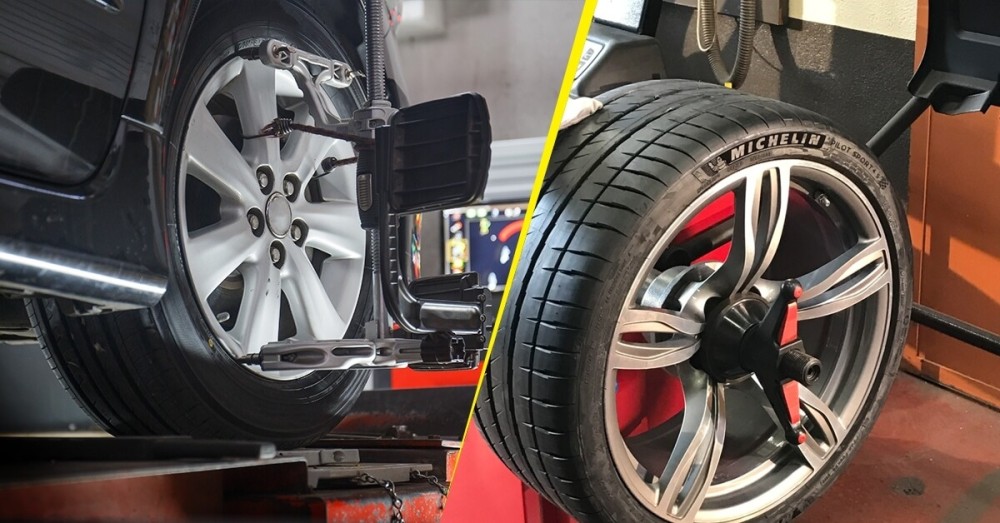
A road-force balancing machine presses a roller against the tire while spinning it. This simulates load and measures variations that a conventional free-spinning balancer may miss. The technician may be able to rotate the tire on the wheel so the stiffest part of the tire and lowest point of the rim compensate for one another.
If balancing does not cure the shake, the inspection should expand to wheel runout, tire condition, suspension joints, wheel bearings and driveshaft components. Vibration under acceleration may point toward an axle or driveline problem. Vibration felt mainly while braking suggests brake rotors or another braking issue rather than ordinary imbalance.
A sudden shake immediately after tire work also deserves a prompt return visit. The wheels may need rebalancing, but loose wheel fasteners must be ruled out first. Severe vibration, knocking or wandering should never be driven at highway speed while waiting to see whether it improves.
Wheel alignment remains valuable when the vehicle pulls, the steering wheel sits crooked or the tires show edge wear. It may be needed alongside balancing, particularly if irregular wear has already developed.
The symptom should choose the service. When the steering wheel behaves beautifully around town and starts objecting at 65 mph, the rotating tire and wheel assemblies deserve the first serious look.