
Britain’s First Armored Car Was 28 Feet Long and Armed Like a Small Warship
by AutoExpert | 23 September, 2026
Before tanks had tracks, someone had to imagine that an engine, armor and heavy weapons might belong on the same vehicle.
Frederick Richard Simms did more than imagine it. At the end of the 19th century, when many people still considered the motorcar an unreliable novelty, the British engineer began transforming the new machine into a weapon.
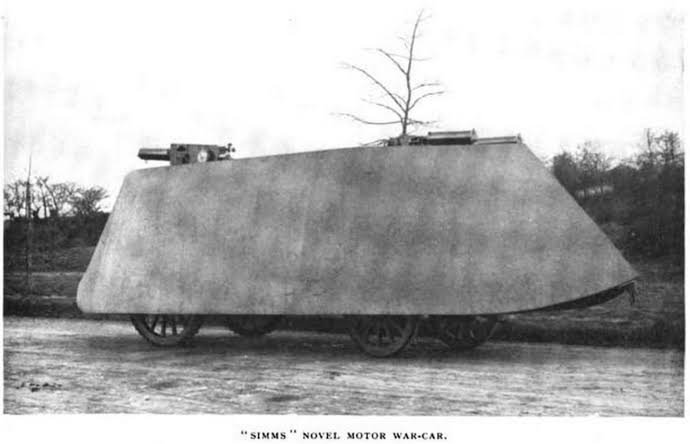
The result was the Simms Motor War Car, widely described as the first purpose-built armored car. It was enormous, slow and deeply impractical. It was also a remarkably clear preview of how mechanized warfare would develop.
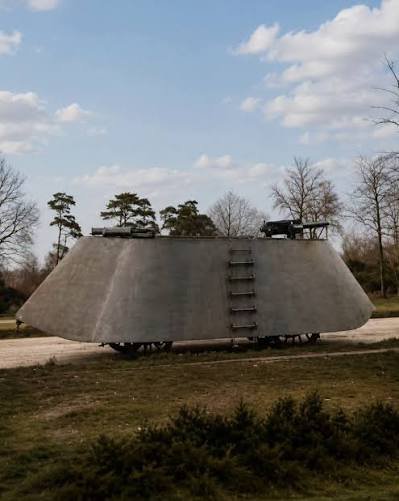
Seen in photographs, it resembles an overturned metal boat that has accidentally grown wheels and gun turrets. This was not a vehicle that crept up on anyone.
Simms started with a machine gun on a quadricycle
Simms was an important figure in early British motoring. He helped introduce Daimler technology to Britain, worked on automotive electrical equipment and played a role in establishing organizations that represented motorists and manufacturers.
He was also interested in military applications.
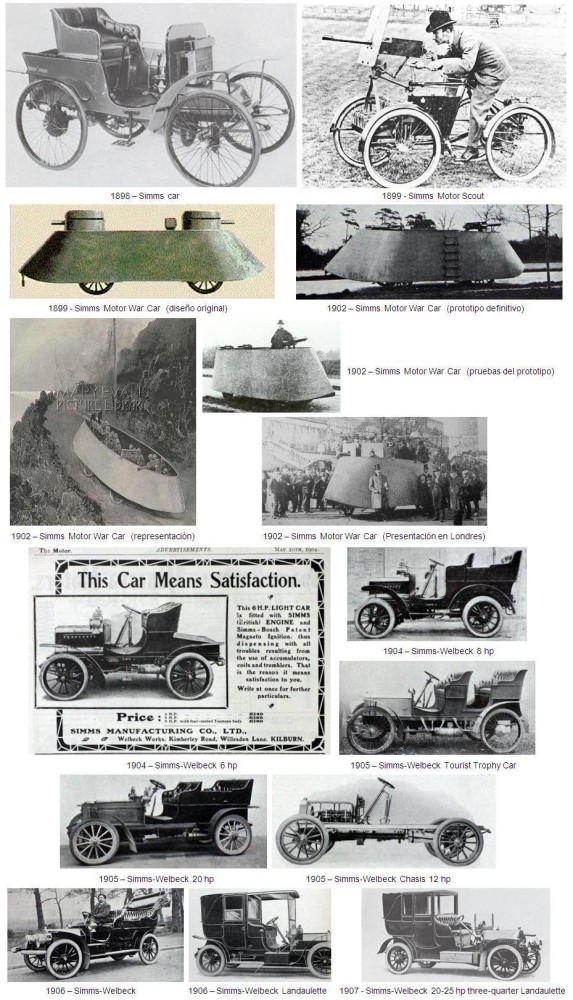
His first armed vehicle, the Motor Scout, was created around 1898. It placed a Maxim machine gun and a protective shield on a motorized quadricycle. The driver sat exposed behind the weapon, with his own body providing much of the protection that the vehicle did not.
The Motor Scout demonstrated that a small petrol engine could move a weapon quickly along a road. It also demonstrated that the operator would be in a terrible position if anyone fired back.
Simms’ next design addressed that weakness with considerably more metal.
The Motor War Car was ordered in 1899 and constructed with help from Vickers, Sons & Maxim. Instead of mounting a gun on an existing passenger car, Simms conceived a dedicated armored machine around a specially prepared Daimler chassis.
That is why it is frequently called the first armored car, although historical “firsts” become complicated when several inventors are experimenting at almost the same time. A French Charron, Girardot et Voigt armored vehicle was publicly displayed in Brussels shortly before Simms presented his completed machine in London. Simms’ design and order came earlier, while its construction took several years.
Whichever vehicle receives the title, the Motor War Car was among the first serious attempts to build a road-going armored fighting vehicle from the ground up.
It was the size of a bus and powered like an early car
The dimensions were extraordinary. The finished Motor War Car was approximately 28 feet long, eight feet wide and around ten feet high. Its armor was about six millimeters thick, while its hull had pointed structures at the front and rear that could serve as rams.
Two Maxim machine guns were installed in rotating positions, giving the crew a far wider field of fire than a fixed weapon could provide. Some descriptions also mention a one-pounder quick-firing gun as part of the proposed armament.
It looked like a small naval vessel lowered onto a road chassis, which was not entirely accidental. Early designers often borrowed the language and logic of warships when imagining armored land vehicles. The rounded metal body, gun positions and rams made Simms’ creation feel like a boat expected to sail into battle along a country road.
Power came from a four-cylinder Daimler engine producing approximately 16 horsepower. That was enough for a top speed of roughly nine miles per hour under favorable conditions.
Sixteen horsepower in a heavily armored, 28-foot fighting machine was optimistic even by the forgiving standards of early motoring. Hills, soft ground and damaged roads were not its friends. The large body also created a magnificent target.
Still, the design included ideas that would become normal in later armored vehicles: an enclosed crew compartment, all-around protection, multiple weapons and the ability to fire in different directions without turning the entire machine.
The war finished before the War Car did
The timing could scarcely have been worse.
The British Army ordered the prototype shortly before the Second Boer War began in 1899. South Africa appeared to offer a convincing reason for a mobile, protected weapon. Distances were large, mounted forces mattered and conventional infantry could be vulnerable in open terrain.
Construction did not proceed smoothly. Technical difficulties and damage from a road accident reportedly delayed the vehicle. The finished Motor War Car was finally presented at Crystal Palace in April 1902.
By then, the conflict it had been expected to serve was almost over. The Treaty of Vereeniging ended the war the following month.
The British military did not order a production fleet. The Motor War Car’s dependence on reasonably firm roads limited its tactical value, while its weight and modest engine left little reserve for difficult terrain. A horse could go places the armored machine could not, and a broken horse did not require a specialist gearbox component.
The project stopped at one prototype.
A failure that pointed in the right direction
Judged as a practical military vehicle, the Motor War Car achieved very little. It entered no battle, inspired no production run and disappeared while lighter armored cars developed along more manageable lines.
Yet its underlying idea was sound.
A vehicle could protect its crew, carry weapons and move under its own power. The challenge was reducing weight, improving engines and finding a way to travel once roads ended. Wheeled armored cars became useful for reconnaissance and patrol work, while tracked vehicles eventually supplied the cross-country ability needed to cross trenches and churned ground.
Britain first used tanks in combat in 1916, only 14 years after Simms displayed his metallic giant. Those early tracked machines were crude, slow and mechanically troublesome, qualities the Motor War Car would have recognized immediately.
The Simms vehicle never became the future of warfare. It looked at the future, however, and identified its basic ingredients with uncomfortable accuracy.