
Your Car Pulls Right on One Road and Left on Another. The Alignment May Be Innocent
by AutoExpert | 5 August, 2026
The car drifts gently toward the shoulder, and suspicion immediately falls on the alignment.
That is understandable. A car should travel where it is pointed, and anything that seems to tug at the steering wheel feels mechanical. Yet the same car may take the opposite view a few miles later, easing left in another lane without anyone touching a suspension bolt.

The road may be doing the steering.
Most roads are not perfectly flat. They are built with a slight crown or slope so rainwater runs away instead of collecting in the traffic lane. A car naturally tends to drift toward the lower side of that surface.
On a typical road, that may mean a gentle movement toward the right shoulder. On a divided highway, the left lane may slope toward the median while the right lane slopes toward the outside. The same car can therefore drift in different directions on the same journey.
The road-crown clue
A pull caused by alignment, a tire or a dragging brake usually remains more consistent. Road influence changes with the pavement.
That does not mean testing the car by releasing the steering wheel at highway speed. It means noticing how much effort is required to maintain a straight course on several familiar roads, preferably in calm weather and with both hands where they belong.
If the car gently follows the slope right in one lane and left in another, the alignment may be perfectly acceptable. Nissan’s technical guidance notes that vehicles naturally drift toward the lower side of a crowned road. General Motors has issued similar guidance, explaining that road-crown influence is environmental and cannot be corrected through suspension adjustment.
The word “gently” matters. A steep road can produce an obvious drift, but a car that darts toward the shoulder or requires a firm, continuous correction still needs inspection.
Begin with the tires
Before paying for an alignment, check all four tire pressures when cold. A pressure difference across the front axle can make the car feel as though something underneath has shifted.
Then look at the tread. Uneven wear, exposed cords, cupping or a heavily worn shoulder suggests that the problem has been present for some time. Tires can also produce a directional pull because of internal construction differences, even when the alignment measurements are correct.
A technician may diagnose this by changing the position of suitable tires and observing whether the pull changes direction. That is not a test to perform casually with directional tires, staggered wheel sizes or vehicles with strict tire-matching requirements. Michelin recommends professional diagnosis when a pull remains despite even wear and correct alignment.
Cargo can influence the car too. A heavily loaded trunk, uneven passenger weight, roof cargo or a trailer can alter how the vehicle sits and responds. Strong crosswinds create another convincing impersonation of bad alignment.
When the pull really is a warning
A car that consistently pulls the same way on different roads deserves attention, particularly if the steering wheel no longer sits straight.
A pothole or curb strike can change alignment. Worn suspension joints or damaged components can do the same. Misalignment often leaves evidence in the tire wear, but a recently developed problem may affect handling before the tread shows an obvious pattern.
Brakes are another possibility. If the car changes direction mainly while braking, one side may be applying more force than the other. A sticking caliper can also create drag while cruising, sometimes accompanied by a hot smell or noticeably higher heat from one wheel.
Do not touch the brake or wheel to compare temperatures. A dragging brake can make the surrounding components hot enough to burn skin.
A sudden severe pull, unstable steering, grinding noise or major vibration is not a “book an alignment next month” situation. The car should be inspected before ordinary driving continues.
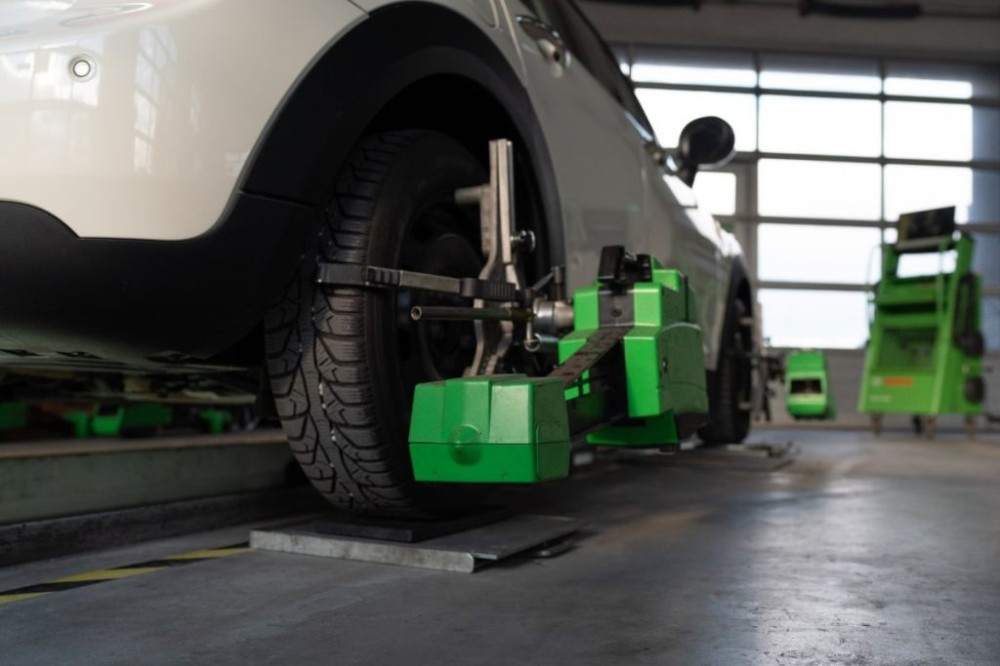
An alignment machine cannot flatten the road
Modern alignment equipment can measure wheel angles with impressive precision. What it cannot do is remove the slope from the street outside the workshop.
That is why a useful diagnosis begins with the conditions in which the pull appears. Does it change direction with the lane? Is it present only while braking? Did it begin after a pothole? Are the tire pressures equal? Is the steering wheel off-center even on flatter pavement?
Those details separate a car following the landscape from one asking for repair.
A slight drift toward the low side of the road is often normal. A persistent pull is not. Before authorizing adjustments, make sure the car is the culprit and not the civil engineer who made certain the rain had somewhere to go.